What Is India VIX and Why It Changes Your Option Premiums
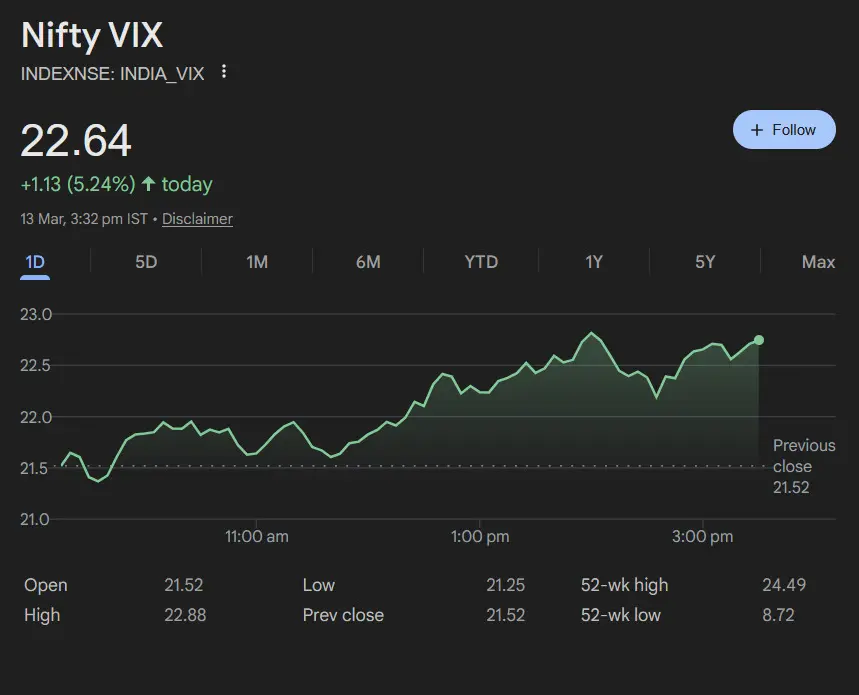
Six weeks ago, India VIX was sitting quietly below 9. Option premiums were cheap, straddles were affordable, and most traders were barely paying attention to it. Today, as this article goes out on 14 March 2026, VIX is trading at 22.65, up more than 160% from that low. The straddle that cost you ₹200 in January now costs ₹480. Nothing about Nifty's direction changed that number. VIX did. If you trade Nifty options and you are not watching India VIX every single morning, you are flying blind.
In This Article
- What India VIX Actually Is
- How It Is Calculated (Without the Maths)
- The Direct Link Between VIX and Your Option Premiums
- What VIX at 22 Means for Traders Right Now
- How to Read VIX Levels: A Practical Reference
- The IV Crush Trap: When VIX Falls and Your Profits Disappear
- How to Use India VIX in Your Trading Decisions
What India VIX Actually Is
India VIX is a number published by the National Stock Exchange every few seconds during market hours. It tells you how much volatility the options market is expecting in the Nifty 50 over the next 30 calendar days. That's it. It does not tell you which direction Nifty will move. It tells you how violently it might move.
The full name is India Volatility Index. NSE introduced it in 2008, modelled on the CBOE VIX used in US markets. Traders call it the fear gauge because it tends to spike when something frightening is happening in the market and fall when things calm down.
Think of it this way. Imagine two different weeks in Nifty's history. In the first week, Nifty is grinding slowly upward, moving 50 to 80 points a day, no news, no surprises. In the second week, Nifty is swinging 400 to 600 points a day because of a geopolitical crisis, an RBI policy shock, or an election result. Both weeks Nifty is "moving." But the second week's movement is far more violent and unpredictable. VIX measures the difference between those two weeks. Right now, we are firmly in the second type of week.
How It Is Calculated (Without the Maths)
You do not need to understand the formula to use VIX effectively. But knowing the basic logic helps you understand why it moves the way it does.
NSE calculates India VIX using the live order book of Nifty options contracts, specifically the bid and ask prices of out-of-the-money calls and puts for the near-month and next-month expiries. The idea is straightforward: when traders expect big moves, they are willing to pay more for options. When they expect calm, they pay less. The prices traders are actively quoting in the options market at any given moment contain a built-in expectation of how much Nifty will move. VIX extracts that expectation and expresses it as a single annualised percentage number.
When you see India VIX at 22, the interpretation is roughly this: the options market is pricing in an annualised volatility of 22% for Nifty. To translate that into a monthly expectation, divide by the square root of 12. At VIX 22, that works out to approximately 6.35% of expected Nifty movement over the next 30 days. With Nifty around 23,200 today, that implies a potential swing of roughly 1,470 points in either direction over the next month. That is what the options market believes is a realistic range right now.
The Direct Link Between VIX and Your Option Premiums
This is the part that matters most for your actual trading. VIX and option premiums move in the same direction. When VIX goes up, premiums go up. When VIX comes down, premiums shrink. This relationship is not approximate or occasional. It is mechanical and constant.
Here is why. The Black-Scholes model, which is the standard formula for pricing options, uses implied volatility as one of its key inputs. Implied volatility and India VIX are measuring the same thing from different angles. When VIX rises, the implied volatility baked into every option on the Nifty index rises with it. Higher implied volatility means a larger expected price range for Nifty, which means options are worth more because there is a better chance the market reaches your strike price.
Let's make this concrete with real numbers from the current environment.
| Period | India VIX level | Approx. Nifty ATM weekly straddle cost | What changed |
|---|---|---|---|
| January 2026 (calm market) | ~9–10 | ~₹150–200 | Low fear, low premium, cheap to buy options |
| Late February 2026 (pre-war) | ~11–12 | ~₹220–260 | Early geopolitical nerves; slight premium rise |
| 4 March 2026 (war shock) | ~21 | ~₹400–450 | US Iran war + Hormuz closure priced in sharply |
| 9 March 2026 (VIX peak) | ~24 | ~₹480–520 | Gulf production cuts; Brent at $119; maximum fear |
| 14 March 2026 (today) | 22.65 | ~₹440–470 | IEA reserve release partially calms oil; VIX easing but still elevated |
That straddle went from ₹180 to ₹500 in six weeks. Nifty's strike price did not change. The expiry did not change. The only thing that changed was VIX, and with it, the implied volatility embedded in every single option on the board.
For buyers, this is painful. You are now paying nearly three times what you would have paid in January for exactly the same position. For sellers, the premium looks attractive, but the risk of the kind of violent gap moves we have seen this month is exactly why that premium is so high. The market is not being generous. It is being accurate.
See How VIX Changes Your P&L in Real Time. For Free.
NiftyWise's simulator lets you trade through historical VIX events. Watch exactly how premium expands and contracts as volatility moves. ₹10 lakh virtual capital. Zero real money.
Launch Free Simulator →What VIX at 22 Means for Traders Right Now
India VIX has spent most of the past two years comfortably below 15. A reading of 22 today is not just "a bit elevated." It represents a market environment that is fundamentally different from what most active retail traders have been operating in for the past 18 months.
The 52-week range for India VIX tells the full story: a low of 8.72 and a high of 24.49. The low was hit just months ago. The high was hit on 9 March 2026 as Brent crude touched $119 and the Strait of Hormuz closure looked permanent. Today's reading of 22.65 is near the top of that range. For context, VIX crossed 20 on 4 March for the first time since May 2025, then surged a further 20.57% in a single session on 9 March to hit 23.97, its highest since July 2024.
What does this mean practically? Three things.
Every option you buy is significantly more expensive than usual
With VIX at 22 versus the 9–10 it was at in January, the implied volatility component baked into option premiums has more than doubled. You are not getting more value for that extra money. You are just paying a higher fear premium. If VIX normalises back toward 12–14 while you hold a long option position, you will experience IV crush, a situation where the option loses value even if Nifty moves in your favour.
Gap risk is real and large
During the first two weeks of March, Nifty moved 400 to 685 points in single sessions. That is not a normal trading environment. It is the kind of environment where overnight positions in short options strategies like naked puts or uncovered calls can suffer losses that exceed several weeks of collected premium in a single gap opening. This is not theoretical. We saw it on 4 March.
The VIX level itself is tradeable information
If you believe the war will end in the short term and VIX will normalise, strategies that benefit from a fall in implied volatility become interesting. Calendar spreads and short straddles at elevated VIX levels have historically provided strong risk-adjusted returns after geopolitical shocks, as long as you time the entry after the peak rather than into it.
How to Read VIX Levels: A Practical Reference
There is no universal definition of "high" or "low" for India VIX. It depends on the context. But based on historical behaviour since NSE introduced it in 2008, here is a practical reference for how different VIX levels tend to affect the trading environment.
| VIX range | Market environment | What it means for option buyers | What it means for option sellers |
|---|---|---|---|
| Below 12 | Calm, low fear. Market trending steadily or range-bound. | Premiums cheap. Good time to buy options if you have a view. Limited IV crush risk. | Premium collected is thin. Limited reward for the risk taken. |
| 12–15 | Normal market. Moderate activity, no major event pricing. | Standard conditions. Premium fair for the risk. | Decent premium, manageable gap risk. Typical trading environment. |
| 15–20 | Elevated uncertainty. An event or risk is being priced in. | Premium getting expensive. Directional bets need stronger conviction. | Fat premium but watch your position size. Gap moves more frequent. |
| 20–30 | High fear. Major event in play. This is where we are today. | Premium expensive. IV crush risk is high. Size down significantly. | Very fat premium but gap risk is severe. One bad session can erase weeks of gains. |
| Above 30 | Extreme fear. Crisis territory. COVID March 2020 hit 87. | Premiums at extreme levels. IV crush when crisis resolves is violent. | Extremely high premium, but position sizing must be tiny. Tail risk is real. |
The all-time high for India VIX was 92.5 in November 2008 during the global financial crisis. The second highest was 87 in March 2020 during the COVID crash. Both events caused extraordinary option premium expansion followed by equally extraordinary IV crush when markets stabilised. Traders who sold premium into those two peaks at the right time made exceptional returns. Traders who bought premium at those peaks and held through the normalisation often saw their options lose value even as markets stayed volatile.
The IV Crush Trap: When VIX Falls and Your Profits Disappear
This is possibly the most important concept for anyone buying Nifty options right now, so I want to spend a bit more time on it.
IV crush happens when implied volatility falls sharply after a spike. It is called a crush because it feels like the value is being squeezed out of your option even while you watch the market do exactly what you expected. Here is how it plays out in the current environment.
Say you buy a Nifty 23,000 PE today at VIX 22, paying ₹420 in premium because you believe Nifty will continue falling due to the Iran war. Over the next seven days, a ceasefire signal emerges, oil prices fall, and VIX drops from 22 to 13. Even if Nifty itself only recovers 200 to 300 points from its lows, the premium on that put option could fall from ₹420 to ₹180 or lower. The implied volatility component, which was worth roughly ₹240 when you bought, has been wiped out by the VIX normalisation. Your directional read was partially correct. Your P&L is deeply negative.
This is not a rare outcome. It is the standard outcome when traders buy options after a VIX spike rather than before one.
"Buying options when VIX is high because you are scared is almost always the wrong trade. The market has already priced the fear into the premium. You arrive late to a party that already ended."
The opposite is also true
If you can identify a period when VIX is abnormally low, option buying becomes exceptionally attractive. At VIX 8.72 in early 2026, a Nifty ATM weekly straddle cost around ₹150. Anyone who bought that straddle before the Iran war broke out would have seen it expand to ₹480 within days. The trade was not about direction. It was about recognising that VIX at near-record lows was an unsustainably cheap environment for options, and that any significant event would trigger a sharp premium expansion.
Practice Trading Through a VIX Spike. Without Losing Real Money.
NiftyWise's simulator includes historical high-VIX scenarios. See exactly how IV crush works, how premiums behave during geopolitical events, and test your strategy before using real capital.
Try the Simulator Free →How to Use India VIX in Your Trading Decisions
Knowing what VIX is and knowing how to use it are two different things. Here is a practical framework for incorporating VIX into your daily Nifty options routine.
Check VIX before you check Nifty's price
This sounds counterintuitive but it matters. Nifty's price tells you where the market is. VIX tells you how much the options you are about to buy or sell are going to cost and how reliably you can estimate their behaviour. A Nifty at 23,000 with VIX at 10 is a completely different trading environment from Nifty at 23,000 with VIX at 22. The instrument is the same. The conditions are not.
Use VIX to size your positions
When VIX is significantly above its recent average, reduce your position size. This is not a suggestion. It is risk management arithmetic. At VIX 22, a one-lot position carries roughly double the daily P&L swings of the same position at VIX 11. If your account can comfortably handle a 2-lot position in a VIX 11 environment, a 1-lot position is the equivalent risk in a VIX 22 environment. Experienced traders who failed to adjust position size during the VIX spike of early March 2026 paid for it on 4 March and 9 March.
Watch VIX direction, not just its absolute level
A VIX falling from 24 to 20 is more important for option buyers than a VIX steady at 20. The direction of change tells you whether premium is expanding or compressing. A falling VIX is a headwind for option buyers regardless of what Nifty is doing. A rising VIX is a tailwind. Tracking daily VIX movement alongside Nifty price gives you a much more complete picture of whether conditions favour buying or selling premium.
Match your strategy to the VIX regime
🎯 India VIX explained: the short version
- India VIX measures the Nifty options market's expectation of volatility over the next 30 days. It does not predict direction. It measures intensity.
- VIX and option premiums move together, always. When VIX doubles, premiums roughly double. When VIX halves, premiums shrink accordingly.
- Today, 14 March 2026, India VIX is at 22.65. Six weeks ago it was at 8.72. The Iran war and Hormuz closure caused this spike. The 119% year-to-date rise is one of the sharpest in recent history outside of COVID and the 2008 crisis.
- IV crush is the trap that catches most option buyers. If you buy premium when VIX is already high and VIX normalises, you lose money even if you got the direction right.
- The rule is simple: low VIX favours buying options, high VIX favours selling options with defined risk structures. Right now we are in high VIX territory.
- Check VIX every morning before you decide whether to buy or sell. It changes the entire cost basis of your trade and should change your strategy and position size accordingly.
Frequently Asked Questions About India VIX
What is a good India VIX level for options trading?
There is no universally "good" level, but for option buyers, a VIX below 12 to 13 offers the cheapest premiums and the most room for IV expansion to work in your favour. For option sellers, a VIX above 18 to 20 provides fat premiums, though gap risk rises with it. The most dangerous scenario for buyers is entering when VIX is already elevated, as premium costs are high and the risk of IV crush on a reversal is significant.
Why did India VIX rise 119% year-to-date in early 2026?
The dominant driver was the US Iran war that began on 28 February 2026. The conflict triggered a near-closure of the Strait of Hormuz, a sharp spike in crude oil prices from $71 to as high as $119 per barrel intraday, and significant FII selling from Indian equities. Each of these factors increased uncertainty about Nifty's near-term range, causing options traders to pay more for protection, which mechanically drove VIX higher.
Can I trade India VIX directly?
Not directly. India VIX is a computed index, not a tradable security. You cannot buy or sell VIX itself. However, NSE does offer India VIX futures contracts, which allow experienced traders to take a position on whether volatility will rise or fall. For most retail traders, the more practical approach is to use VIX as a reference to shape strategy selection and position sizing on Nifty options, rather than trading VIX directly.
What happens to my existing option positions when VIX spikes suddenly?
If you are long options (you bought calls or puts), a VIX spike is generally beneficial. The premium on your options increases as implied volatility rises, adding to your P&L even before Nifty moves. If you are short options (you sold calls or puts), a VIX spike is harmful. The options you sold become more expensive to buy back, and your margin requirements may increase. This is why short option positions need much tighter management during periods of geopolitical uncertainty like the present one.
How is India VIX different from the US VIX?
Both measure market expectations of volatility using the same conceptual framework developed by the CBOE. The primary difference is the underlying. India VIX is derived from Nifty 50 index options, while the US VIX is derived from S&P 500 options. Both tend to spike during their respective market crises and fall during calm periods. The two can diverge significantly when the cause of uncertainty is domestic to one market. Currently, both are elevated: India VIX at 22.65 and the CBOE VIX around 27, reflecting the global impact of the Iran war on both markets.
⚠️ Disclaimer: Please Read. This article represents the personal opinions and analysis of the NiftyWise editorial team based on publicly available information as of 14 March 2026. It is for educational purposes only and does not constitute investment advice, a trading recommendation, or financial guidance of any kind. India VIX levels, market conditions, and the geopolitical situation referenced in this article are subject to rapid change. Please verify all data independently before making any trading decisions. NiftyWise is not registered with SEBI as an Investment Adviser, Research Analyst, or Stockbroker. All figures are approximate. Past performance, simulated or actual, is not indicative of future results. Options trading carries substantial risk. As per SEBI's study on the equity F&O segment (FY 2021–22): 9 out of 10 individual traders in the equity F&O segment incurred net losses. Please consult a SEBI-registered Investment Adviser before making any investment decisions. Visit sebi.gov.in for a list of registered advisers.