Tax & Compliance · All Levels
F&O Tax in India 2026: Slabs, STT and ITR Explained
Most Nifty options traders assume profits are taxed like stock market gains: at 20% STCG or 12.5% LTCG. They are completely wrong, and this assumption causes both underpayment and missed deductions.
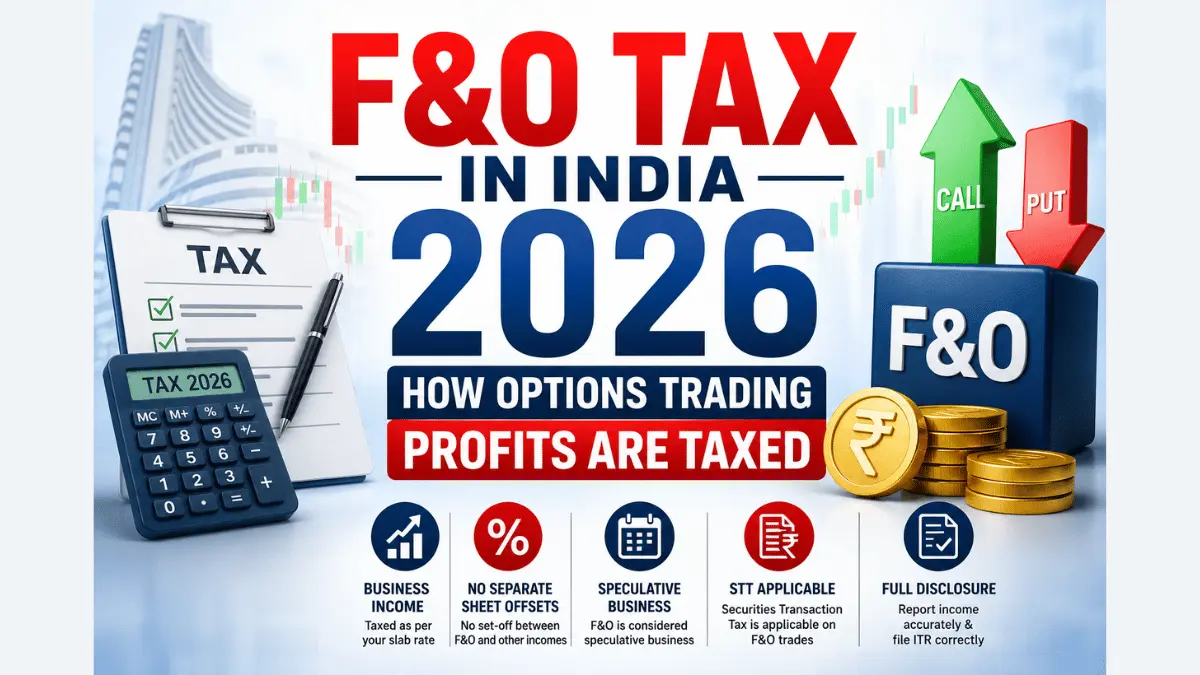
F&O trading tax India 2026 works entirely differently from equity investing. F&O profits are business income, taxed at your slab rate. F&O losses can offset rent and interest income in the same year. The Income Tax Act 2025, which replaced the 1961 Act from April 1, 2026, retained these rules with updated section numbers and new STT rates from Budget 2026.
This article is educational. F&O tax involves facts unique to each trader's income, history, and filing status. Always consult a Chartered Accountant before filing your return.
Jump to
- How F&O Income Is Classified Under the Income Tax Act 2025
- What Changed From April 1, 2026
- Tax Rates: What You Actually Pay
- How to Calculate F&O Turnover (Updated ICAI Method)
- When a Tax Audit Is Mandatory
- F&O Losses: Set-Off and Carry Forward Rules
- Expenses You Can Claim as Deductions
- Filing Your Return: ITR-3, Due Dates, and What Happens If You Miss Them
- Advance Tax for F&O Traders
- The Five Most Costly F&O Tax Mistakes
How F&O Income Is Classified Under the Income Tax Act 2025
The foundational rule
Under Section 66 of the Income Tax Act 2025 (which replaced Section 43(5) of the 1961 Act), income from trading in Futures and Options on recognised stock exchanges is classified as non-speculative business income under the head "Profits and Gains from Business or Profession" (PGBP).
This single classification determines everything: your tax rate, the form you file, how losses work, and what expenses you can deduct. It applies whether you trade one lot per month or five hundred per week, whether you make a profit or a loss, and whether F&O is your only income or one of several.
The non-speculative classification is what distinguishes F&O from intraday equity trading. Intraday equity (buying and selling stocks within the same day without delivery) is classified as speculative business income, which carries stricter loss set-off rules. F&O, despite also having no delivery in most contracts, is treated as non-speculative because the contracts are exchange-traded, standardised, and regulated, which are the factors that the law uses to draw the distinction.
The practical consequence of the non-speculative classification is significant and largely favourable: F&O losses can be offset against rental income, interest income, and business income in the same year. Speculative losses can only be offset against other speculative income. This is one of the most valuable tax benefits F&O traders have and one of the least discussed.
What most traders think
- F&O profits taxed at 20% (STCG)
- Only active traders need to file
- Losses just mean no tax, nothing else
- Same ITR form as equity investments
How it actually works
- F&O profits taxed at your income slab
- Even one F&O trade means ITR-3
- Losses reduce other taxable income now
- ITR-1 or ITR-2 triggers a defective notice
What Changed From April 1, 2026
Two significant changes took effect at the start of the current Tax Year (April 1, 2026). Understanding both is essential before discussing the core tax framework.
1. The Income Tax Act 2025 replaced the 1961 Act
The Income Tax Act 2025 came into force from April 1, 2026, replacing the Income Tax Act of 1961 that had governed Indian taxation for six decades. For most F&O traders, the core tax treatment is unchanged. F&O income remains non-speculative business income. Loss carry-forward rules remain at eight years. ITR-3 remains the correct form. The primary changes are structural: simplified language, reorganised section numbering (Section 43(5) of the 1961 Act is now Section 66 of the 2025 Act), and a shift from the "Financial Year / Assessment Year" framework to a single "Tax Year" concept. Tax Year 2026-27 covers income earned from April 1, 2026 to March 31, 2027.
2. STT rates increased on F&O (Budget 2026)
Announced in Union Budget 2026 and effective April 1, 2026, Securities Transaction Tax (STT) on F&O trades increased:
| Segment | Old STT rate | New STT rate (from Apr 1, 2026) | Applied on |
|---|---|---|---|
| Futures (F) | 0.02% | 0.05% | Sell side (turnover) |
| Options (O) | 0.10% | 0.15% | Sell side (premium value) |
STT is not an income tax. It is a transaction-level charge collected at the exchange, deducted from your account automatically. It is deductible as a business expense against your F&O income when computing taxable profit.
Tax Rates: What You Actually Pay
F&O profits are added to your total income from all sources and taxed at the applicable income slab rate under the new default tax regime (Section 202 of the Income Tax Act 2025, previously Section 115BAC of the 1961 Act).
| Total Income (from all sources) | Tax Rate (New Default Regime) |
|---|---|
| Up to Rs 4,00,000 | Nil |
| Rs 4,00,001 to Rs 8,00,000 | 5% |
| Rs 8,00,001 to Rs 12,00,000 | 10% |
| Rs 12,00,001 to Rs 16,00,000 | 15% |
| Rs 16,00,001 to Rs 20,00,000 | 20% |
| Rs 20,00,001 to Rs 24,00,000 | 25% |
| Above Rs 24,00,000 | 30% + applicable surcharge |
Add 4% Health and Education Cess on total tax. Surcharge applies for very high incomes. The new regime is the default from Tax Year 2026-27. To opt for the old regime, file Form 10-IEA. F&O traders who switch from the old to new regime can switch back only once in a lifetime.
The critical point for most salaried F&O traders: your F&O profit is added on top of your salary before the slab rate is applied. If your salary puts you in the 30% bracket and you earn Rs 3 lakh from F&O, that Rs 3 lakh is taxed at 30% (plus cess), not at the lower slabs. There is no special treatment or flat rate for F&O income. It is ordinary income.
A concrete example
Ananya is a salaried professional in Mumbai earning Rs 18 lakh per year. In Tax Year 2026-27 she also makes Rs 4 lakh net profit from Nifty options trading. Her total income is Rs 22 lakh. Under the new regime, Rs 20 lakh falls under the 25% slab and the remaining Rs 2 lakh at 30%. Her F&O profit effectively gets taxed at the marginal rate applicable to her combined income. She cannot treat the F&O profit separately or apply a lower flat rate to it.
How to Calculate F&O Turnover (Updated ICAI Method)
F&O turnover is one of the most misunderstood concepts in trading taxation and one of the most consequential. It determines whether a tax audit is required and which presumptive scheme you qualify for.
Critical: F&O turnover is NOT the total contract value of your trades
Many traders confuse trading volume (crores of contract notional) with taxable turnover. They are completely different. The NSE may show your total traded value as Rs 50 crore for the year. Your taxable F&O turnover under the ICAI method may be Rs 8 lakh. The distinction matters because audit thresholds are based on the ICAI turnover, not notional volume.
The correct formula (ICAI 8th Edition Guidance Note, August 2022)
Turnover is calculated as the sum of absolute profit and absolute loss on each trade, computed trade by trade throughout the year.
F&O Turnover = |Profit on Trade 1| + |Loss on Trade 2| + |Profit on Trade 3| + ...
This update to the formula (effective from Assessment Year 2022-23 under the 2022 Guidance Note) is critical: the premium received on the sale of options is no longer separately included in turnover. Before August 2022, options turnover included both absolute profit/loss AND the full premium received on sold options. The updated method uses only the absolute profit/loss. This typically reduces options traders' computed turnover by 40 to 60%.
Worked example
Rajesh trades Nifty weekly options through Tax Year 2026-27. His trade outcomes for the year:
| Trade | Result | Absolute value (turnover) |
|---|---|---|
| 50 buy trades, avg profit Rs 3,500 each | +Rs 1,75,000 | Rs 1,75,000 |
| 80 buy trades, avg loss Rs 2,800 each | -Rs 2,24,000 | Rs 2,24,000 |
| Total | -Rs 49,000 (net loss) | Rs 3,99,000 (turnover) |
Rajesh's net loss is Rs 49,000. His F&O turnover is Rs 3,99,000 (under Rs 1 crore). No tax audit required. He should still file ITR-3 and report the loss to carry it forward.
You can obtain your F&O turnover data directly from your broker's BOX (back office) in the Tax P&L report. TradeSmart's back office reports include a dedicated Tax P&L and P&L report that provide trade-by-trade profit and loss figures needed for this calculation.
When a Tax Audit Is Mandatory
Under Section 44AB of the Income Tax Act (retained with minor renumbering in the 2025 Act), a tax audit by a Chartered Accountant may be required for F&O traders. Since virtually all exchange-traded F&O transactions are digital (over 95%), the relevant threshold for most retail traders is the higher digital limit.
F&O Losses: Set-Off and Carry Forward Rules
This is the part of F&O taxation that actually works in the trader's favour, and most traders never use it correctly.
Same-year set-off: more powerful than most traders realise
F&O losses, being non-speculative business losses, can be set off against any income head in the same year except salary income. This means: if you earn Rs 6 lakh in rental income and Rs 4 lakh from bank fixed deposits, and you have a Rs 5 lakh F&O loss, your net taxable income is reduced to Rs 5 lakh (Rs 6L + Rs 4L - Rs 5L). You saved tax on the full Rs 5 lakh of losses in the same year.
The salary exception is important: you cannot set off F&O losses against your salary. But you can set off against rent, interest, capital gains, and other business income.
Example: Priya earns the following in Tax Year 2026-27
Gross income
Salary: Rs 12,00,000 (cannot be offset)
Rental income: Rs 4,00,000
FD interest: Rs 80,000
F&O net loss: Rs 2,50,000
After F&O loss set-off
Salary: Rs 12,00,000 (unchanged)
Rental: Rs 4,00,000 - Rs 2,50,000 = Rs 1,50,000
FD interest: Rs 80,000 (balance absorbed)
Net taxable: Rs 13,50,000 (saved Rs 2,50,000)
Carry forward: 8 years, with the most important condition
If F&O losses cannot be fully absorbed in the same year, the balance can be carried forward for up to eight tax years. The carried forward losses can only be set off against non-speculative business income in future years. They cannot be offset against salary, rent, or capital gains in future years (only in the same year). The carry-forward benefit is lost permanently if you do not file ITR-3 by the due date. Filing late, even by one day, means the loss carry-forward right is forfeited for that year's losses.
Expenses You Can Claim as Deductions
Since F&O income is business income, you can deduct all genuine business expenses incurred to earn it. These deductions reduce your net taxable F&O profit (or increase your net F&O loss, which can be set off as described above).
Clearly deductible
- Brokerage charges (Rs 15/order or Rs 7/lot)
- STT paid on transactions
- GST on brokerage
- NSE/BSE exchange transaction charges
- SEBI turnover charges
- Stamp duty on contracts
- Internet charges (used for trading)
- Trading software subscriptions
Deductible with proportion
- Phone charges (trading-related portion)
- Advisory or research fees
- Trading books and educational subscriptions
- Computer/tablet depreciation (trading use %)
- Home office expenses (if used for trading)
- CA fees for ITR preparation
- Account maintenance charges (if related)
Keep all receipts and retain broker contract notes and tax P&L statements. These are your primary documentary support for deductions. TradeSmart's back office (BOX) generates these reports automatically under the Reports section: Account Summary, Ledger, Trade Details, Tax P&L, and Contract Notes are all available for download and are precisely the records you need for ITR-3 preparation.
Filing Your Return: ITR-3, Due Dates, and What Happens If You Miss Them
Why ITR-3 is mandatory: no exceptions
Every individual or HUF who has even a single F&O transaction in a tax year must file ITR-3. This applies even if the F&O income is a loss, even if you are a salaried employee who only dabbled in one or two options trades, and even if your total income is below the taxable threshold. Filing ITR-1 or ITR-2 when you have F&O transactions triggers a defective return notice under Section 139(9). The ITR-1 and ITR-2 forms do not have provision for PGBP income, and the income tax system automatically flags returns filed on incorrect forms. ITR-4 (presumptive scheme) is available if you opt for Section 44AD, but comes with the constraints described below.
Due dates (Tax Year 2026-27)
| Situation | Due Date | Consequence of missing |
|---|---|---|
| Non-audit F&O trader (turnover below Rs 10 crore, no audit trigger) | July 31, 2027 | Loss carry-forward forfeited. Late fee Rs 5,000 (Rs 1,000 if income below Rs 5L). |
| Audit-required F&O trader (turnover above Rs 10 crore or audit condition met) | October 31, 2027 | Same loss-forfeiture rule. Penalty under Section 271B for missing audit: 0.5% of turnover (max Rs 1.5 lakh). |
Section 44AD: the presumptive shortcut and its hidden cost
Traders with F&O turnover below Rs 3 crore can opt for Section 44AD presumptive taxation, which allows you to declare a deemed profit of 6% of turnover (or 8% for cash transactions) without maintaining detailed books of account. On the surface this looks attractive: declare 6% profit, pay tax on that, no books required.
The hidden cost: you forfeit the right to carry forward F&O losses under the presumptive scheme. And under Section 44AD(4), if you use presumptive taxation in any year and then opt out in a subsequent year because you have a loss, a mandatory tax audit is triggered for five years following your opt-out. Most active F&O traders who trade at scale are better served by proper PGBP reporting rather than the 44AD shortcut.
Advance Tax for F&O Traders
If your net tax liability for the year is expected to exceed Rs 10,000, you are required to pay advance tax in four instalments rather than as a lump sum at year end. For salaried traders, TDS from salary typically handles most or all of the advance tax obligation. For those with significant F&O income on top of salary, additional advance tax may be required to avoid interest under Sections 234B and 234C.
| Instalment | Due Date | Cumulative % of annual liability |
|---|---|---|
| 1st instalment | June 15 | At least 15% |
| 2nd instalment | September 15 | At least 45% |
| 3rd instalment | December 15 | At least 75% |
| 4th instalment | March 15 | 100% |
Under Section 44AD presumptive scheme, advance tax is paid in a single instalment by March 15. Interest for non-payment or shortfall in advance tax is 1% per month under Sections 234B and 234C.
The Five Most Costly F&O Tax Mistakes
Filing ITR-1 or ITR-2 with F&O trades
Triggers a defective return notice under Section 139(9). F&O income requires ITR-3. Even one options trade in the year means ITR-3 is mandatory. This mistake is extremely common among salaried traders who assume they can use the standard salaried employee form.
Not filing ITR when there is only a loss
Without a timely ITR-3 filing, the right to carry forward F&O losses for 8 years is permanently forfeited. A Rs 2 lakh F&O loss that could offset Rs 2 lakh of future profit (saving Rs 40,000 to Rs 60,000 in tax) is lost forever by not filing.
Using the old options turnover formula
Before August 2022, options turnover included premium received on sale. The updated ICAI 8th Edition method uses only absolute profit/loss. Many online calculators still use the old formula, producing inflated turnover figures that may incorrectly trigger audit requirements or presumptive scheme thresholds.
Falling into the Section 44AD(4) trap
Using presumptive taxation (44AD) in a profit year to avoid books, then switching back to actual reporting in a loss year, triggers a mandatory audit for five years plus loss of carry-forward rights. This trap catches traders every filing season. If you have ever used 44AD for F&O income, consult a CA before filing.
Not claiming all deductible expenses
Brokerage, STT, GST, exchange charges, internet, advisory fees, all deductible against F&O income. A trader paying Rs 50,000 in brokerage and charges per year who does not claim this deduction overpays tax by Rs 10,000 to Rs 15,000 annually (at 20-30% slab). Your broker's Tax P&L report contains most of these figures already aggregated.
📄 F&O Tax 2026: Quick Reference
Is F&O income capital gains?
No. It is non-speculative business income (PGBP), taxed at slab rates (5-30%), not at STCG 20% or LTCG 12.5%.
Which ITR form?
ITR-3. Mandatory for all individuals/HUFs with any F&O trades, including loss-making traders.
How is turnover calculated?
Sum of absolute profit + absolute loss per trade (ICAI 8th Ed, 2022). NOT contract value. NOT including options premium received.
When is a tax audit required?
When turnover exceeds Rs 10 crore (95% digital, which applies to all exchange F&O), or when the 44AD(4) trap is triggered.
Can F&O losses reduce my tax?
Yes. F&O losses offset rental income, interest income, and other business income in the same year (not salary). Can be carried forward 8 years if ITR filed on time.
What expenses are deductible?
Brokerage, STT, GST, exchange charges, SEBI fees, internet, advisory fees, software subscriptions, depreciation on hardware used for trading.
What changed from April 1, 2026?
Income Tax Act 2025 replaced the 1961 Act (structural only, core F&O rules unchanged). STT on futures increased to 0.05%, options STT to 0.15% (Budget 2026).
Frequently Asked Questions
Is F&O income treated as capital gains or business income for tax purposes?
F&O income is classified as non-speculative business income under Section 66 of the Income Tax Act 2025 (previously Section 43(5) of the Income Tax Act 1961). It is not treated as capital gains under any category. This means F&O profits are taxed at your applicable income slab rate (up to 30% plus cess), not at the flat STCG rate of 20% or LTCG rate of 12.5% that applies to equity investments held for delivery. This classification applies regardless of trading frequency, lot size, or whether F&O is your primary or secondary income source.
Do I need to file ITR even if I only made a loss in F&O?
Yes. Filing ITR-3 is mandatory even if your net F&O result for the year is a loss. The reason: without a timely filed return, you permanently forfeit the right to carry forward F&O losses for up to eight years. These carried-forward losses can offset future F&O profits and reduce your tax liability in profitable years. The value of this carry-forward can be substantial. Additionally, the Annual Information Statement (AIS) generated by the income tax department reflects all your F&O transactions automatically via exchange reporting. Failing to file creates a discrepancy that may attract a tax notice even if no tax is owed.
What is the correct way to calculate F&O turnover for tax purposes?
Per the ICAI 8th Edition Guidance Note (effective from Assessment Year 2022-23), F&O turnover is calculated as the sum of the absolute value of profit and absolute value of loss on each squared-off trade during the year. For example: a trade with a Rs 15,000 profit contributes Rs 15,000 to turnover; a trade with an Rs 8,000 loss contributes Rs 8,000. The total of all such absolute figures across the year is your F&O turnover. Importantly, the premium received on the sale of options is no longer separately included in turnover under the updated method. F&O turnover is not the total notional contract value of trades executed. The distinction is critical because audit thresholds are based on this turnover, not trading volume.
When does a tax audit become mandatory for an F&O trader?
For most retail F&O traders whose transactions are entirely digital (exchange-traded, which is the case for all NSE/BSE F&O), a tax audit under Section 44AB is mandatory when F&O turnover exceeds Rs 10 crore in a tax year. Below Rs 10 crore, no audit is required unless the Section 44AD(4) trap is triggered: if you used presumptive taxation in any of the five preceding years and now want to declare a loss or income below 6% of turnover, an audit is mandatory. The audit must be conducted by a Chartered Accountant and filed in Form 3CA/3CB with Form 3CD by October 31 of the assessment year.
Can F&O losses be set off against salary income?
No. F&O losses, being non-speculative business losses, cannot be set off against salary income either in the current year or in carried-forward years. However, they can be set off against rental income, interest income, capital gains, and other non-speculative business income in the same year. Unabsorbed losses can be carried forward for eight years and set off only against non-speculative business income in future years. The inability to offset against salary is one of the few limitations of F&O loss treatment, but the ability to offset against investment income in the same year is a significant benefit that many traders miss.
What are the new STT rates on F&O from April 1, 2026?
Announced in Budget 2026 and effective from April 1, 2026, Securities Transaction Tax (STT) on F&O trades increased as follows: STT on futures rose from 0.02% to 0.05% of the sell-side turnover; STT on options rose from 0.10% to 0.15% of the sell-side premium value. STT is charged automatically by the exchange on each sell-side transaction and deducted from your trading account. Since STT is a legitimate trading expense, it is deductible as a business expense when computing your net taxable F&O income under PGBP. This partially offsets the additional cost through a tax deduction.
Trade at the Lowest Brokerage: Keep More of What You Earn
Since brokerage, STT, and exchange charges are all deductible F&O business expenses, keeping them low directly increases your net taxable profit calculation while keeping more capital available to trade. TradeSmart charges Rs 15 per executed order (Power Plan) or Rs 7 per lot on options (Value Plan), the lowest brokerage at any SEBI-registered broker in India.
And when you need to access your Tax P&L, Ledger, Contract Notes, and Trade Details for ITR-3 preparation, TradeSmart's BOX back office has all these reports ready to download, the exact documents your CA needs.
This is not a paid promotion. The author may earn a commission if you open an account with TradeSmart through the link below. This does not affect editorial independence.
Open a Free TradeSmart Demat Account →⚠️ Disclaimer: Please Read. This article is written by Feroz Omar and published on NiftyWise.org for educational and informational purposes only. This article does not constitute tax advice, legal advice, or a recommendation to adopt any particular tax position. F&O taxation involves facts specific to each individual's income structure, filing history, and jurisdiction. This is not a paid promotion. The author may earn a commission if you open an account with TradeSmart through links in this article; this does not affect editorial independence. All information in this article is based on publicly available sources including the Income Tax Act 2025, ICAI Guidance Notes, and publicly published tax guides as of Tax Year 2026-27. Tax laws change frequently; verify all figures with the official Income Tax Department website (incometax.gov.in) or a qualified Chartered Accountant before filing. Errors or changes after publication are possible. NiftyWise.org is not a tax advisory firm and is not registered with any authority to provide tax advice. Please consult a SEBI-registered Investment Adviser for trading decisions and a Chartered Accountant for tax filing. Visit incometax.gov.in and sebi.gov.in for authoritative guidance.