Options Education · Intermediate
What Is Put Call Ratio (PCR) and How Indian Traders Use It
Put Call Ratio, or PCR, is one of the most referenced numbers in Indian options trading, especially around high-stakes sessions like RBI decisions, Union Budgets, and election results. Every expiry week it appears across social media, YouTube commentary, and Telegram groups as traders try to read which way Nifty is positioned. But PCR is also one of the most misread indicators in retail options trading. A high PCR does not simply mean the market is bullish. A low PCR does not simply mean bearish. Understanding what PCR actually measures, how to read it correctly in context, and where it most commonly misleads is the difference between using it as a useful reference and using it as a reason for a trade that should never have been placed.
In This Article
- What PCR Actually Measures
- Two Types of PCR: OI-Based vs Volume-Based
- How to Read the PCR Number
- The Contrarian Nature of PCR
- Context Is Everything: When the Same PCR Means Different Things
- PCR Around RBI, Budget, and Election Sessions
- Tracking PCR Change Across Sessions
- Using PCR Alongside OI Data: The Right Framework
- The Five Most Common PCR Misreadings
- A Practical PCR Reading Workflow
What PCR Actually Measures
Put Call Ratio is calculated by dividing total put open interest by total call open interest across all strikes in the Nifty option chain for a given expiry. If the Nifty weekly expiry has a combined put OI of 80 lakh contracts and a combined call OI of 60 lakh contracts, the PCR is 80 divided by 60, which equals 1.33.
What this number represents is a relative measure of put activity versus call activity. A PCR above 1 means there are more put contracts open than call contracts. A PCR below 1 means there are more call contracts open than put contracts.
Critically, PCR counts contracts from both sides of each trade. Every put in the open interest has one put buyer and one put seller. The number tells you the total quantity of put exposure active in the market relative to call exposure. It does not tell you which side of those contracts (buyer or seller) is dominant, and it does not tell you whether the puts were bought for directional reasons or as portfolio hedges. Both of those limitations matter enormously for how you interpret the number.
Two Types of PCR: OI-Based vs Volume-Based
PCR comes in two variants that are worth distinguishing, because they answer different questions and have different applications.
OI-based PCR (the standard version)
OI-based PCR divides total put open interest by total call open interest. This is the most widely used version and the one most traders and platforms reference when they say "PCR." It reflects the cumulative positioning that has been built up over multiple sessions, not just today's activity. OI-based PCR is a slow-moving indicator. It changes gradually as large participants build and unwind positions across the weekly cycle. It is the more reliable of the two for understanding the broader market positioning context.
Volume-based PCR (the short-term read)
Volume-based PCR divides today's total put volume by today's total call volume. This is a faster-moving, noisier indicator. It reflects the balance of buying and selling activity happening in the current session, not the accumulated positioning. Volume-based PCR is more sensitive to intraday sentiment shifts and can change dramatically hour by hour. A volume PCR spiking to 1.8 in the first hour of trading might indicate panic put buying in response to a morning news development, which tells you something very different from a steady OI-based PCR of 1.4 built over four sessions.
For most purposes in this article, PCR refers to the OI-based version unless otherwise specified. This is the version most relevant for understanding weekly cycle positioning and is the one displayed prominently in most Indian options analytics platforms.
How to Read the PCR Number
PCR is a continuous number, not a binary signal. The interpretation is not simply "high PCR = bullish, low PCR = bearish." It is far more nuanced than that, and this nuance is where most retail misreadings originate. Here is the baseline framework for reading PCR values.
PCR below 0.8: call-heavy territory
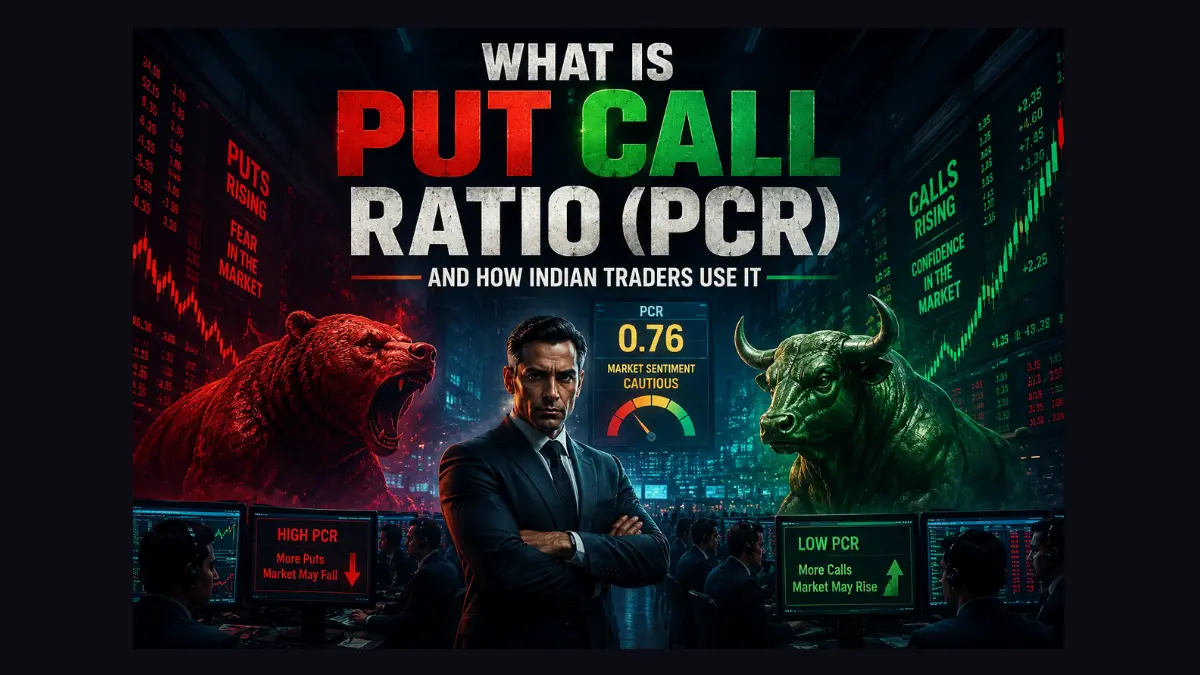
When total call OI significantly exceeds total put OI, the PCR falls below 0.8. In conventional interpretation, this suggests more call writing activity relative to puts. Call writers are sellers who profit if Nifty stays below their strike. A call-heavy option chain can indicate that large participants are positioning for a range-bound or declining market, placing significant selling pressure above current levels. The contrarian interpretation reads this as a potential caution signal: the market may be complacent or there may be overhead resistance from concentrated call writing.
PCR in the neutral zone (0.8 to 1.2)
The majority of regular Nifty trading sessions will produce a PCR in this range. Here, neither calls nor puts dominate by a significant margin. No strong sentiment conclusion can be drawn from the number alone in this zone. This is where most traders make the mistake of searching for meaning where little exists. A PCR of 0.95 and a PCR of 1.05 are both neutral; treating one as bullish and the other as bearish is reading noise as signal.
PCR above 1.2: put-heavy territory
When total put OI significantly exceeds total call OI, the PCR rises above 1.2. Under the standard contrarian interpretation, this is read as a mildly bullish signal. Here is the logic: elevated put OI usually reflects substantial put writing (selling) by large participants. Put writers profit when Nifty stays above their strike. If significant put writing is active below current Nifty, those writers are mechanically committed to defending the downside through delta hedging, creating a support floor. A high PCR is therefore often associated with a market that has institutional backing on the downside. This is the contrarian element: high put activity looks bearish on the surface but often signals bullish institutional positioning through put writing.
The Contrarian Nature of PCR
The reason PCR is a contrarian indicator, rather than a direct one, is rooted in the mechanics of who creates OI. OI is built by option sellers more than by option buyers in most institutional contexts. A large put OI does not primarily reflect institutional traders buying puts to bet on a market fall. It more commonly reflects large participants selling puts to collect premium, betting that Nifty will stay above their strike. These put sellers (writers) create the OI that elevates the PCR.
So when PCR is high, the conventional reading is: large-scale put writing is active, which means institutional participants have significant financial incentive to keep Nifty above a floor. They will hedge by buying Nifty futures as the index approaches their put strikes, creating support. This is why high PCR is associated with a bullish context for the underlying, not a bearish one.
The same logic applies in reverse for low PCR. When call OI significantly exceeds put OI, the usual implication is heavy call writing: large participants selling calls and betting Nifty stays below their strike. They will sell Nifty futures as it approaches their call strike to hedge, creating overhead resistance. Low PCR therefore often signals a market with concentrated resistance above current levels, which is contextually bearish for upside momentum, not the bullish signal the surface "more calls = bullish" reading would suggest.
Context Is Everything: When the Same PCR Means Different Things
A PCR of 1.3 in one session can mean something entirely different from a PCR of 1.3 in another. The number must be read in at least four dimensions of context to be meaningful.
Context 1: Where is Nifty relative to the Put Wall?
PCR gains more meaning when combined with the OI structure. If PCR is 1.3 and the highest put OI is concentrated at a strike 300 points below current Nifty, the "support" being created by those put writers is far away. If PCR is 1.3 and the highest put OI is concentrated very close to current Nifty (within 100 points), the support is immediately relevant and meaningful. The same PCR number with different OI strike distribution tells a completely different story about where the market expects a floor to hold.
Context 2: Where are we in the weekly cycle?
PCR in the first two days of the weekly cycle (Wednesday to Thursday after Tuesday expiry) reflects fresh, early positioning. PCR on Monday or Tuesday of expiry week reflects a combination of positioning and rollover behaviour as participants close expiring contracts and open next-week positions. The PCR reading in the first half of the cycle is generally more meaningful as a positioning read. Near expiry, large OI changes happen rapidly as positions unwind, and the PCR can shift dramatically in a single session without a change in actual market sentiment.
Context 3: Is PCR rising or falling?
The direction of PCR change is often more useful than the absolute level. A PCR that is rising steadily from 0.9 to 1.1 over three sessions suggests accumulating put writing, which implies growing institutional support for the current level and above. A PCR falling from 1.3 to 1.0 suggests put unwinding, which can indicate that the protective floor is weakening. A sudden one-session jump in PCR from 1.0 to 1.5 requires investigation: is it new put writing (bullish support building) or panic put buying (genuine fear)? The direction and rate of change provide context the absolute level does not.
Context 4: What is India VIX doing?
India VIX measures overall implied volatility. When VIX is elevated, option premiums are expensive and hedging demand inflates put OI regardless of directional view. An elevated PCR during high-VIX periods partly reflects hedging, not just directional positioning. When VIX is low, PCR moves are more likely to reflect genuine directional positioning from put or call writing rather than defensive hedging.
PCR Around RBI, Budget, and Election Sessions
PCR behaviour around major scheduled events is one of the most misread phenomena in Indian options trading. Every time the RBI monetary policy committee announces a decision, or the Finance Minister presents the Union Budget, traders rush to read the PCR. Most of them misread it in the same direction.
The pre-event PCR surge
In the days leading up to any major scheduled event, India VIX rises and option premiums expand. Simultaneously, there is a significant demand for put options from institutional traders and large retail accounts seeking to protect existing long positions. This protective put buying drives up put OI and elevates the PCR, often to levels above 1.3 or 1.4 before major events. This looks, on the surface, like a very bullish contrarian signal.
It is not. In this context, the elevated PCR reflects hedging demand, not directional conviction from put writers. The institutions buying these protective puts are not betting on a floor; they are buying insurance. When the event resolves, the hedging puts are typically sold or allowed to expire, and the PCR falls sharply. The PCR reading before a major event carries very little information about where Nifty will actually go after the event.
Budget day PCR behaviour
On Budget day specifically, PCR typically rises through the morning session as participants hedge ahead of the announcement, then collapses in the afternoon as hedges are unwound after the key numbers are disclosed. If you look only at the morning PCR and apply the standard contrarian bullish interpretation, you may misread a hedging-driven elevation as a directional signal. The afternoon PCR, after hedges have been removed, is a more meaningful read of where the market actually stands following the Budget announcement.
RBI decision day PCR
On RBI monetary policy days, the same pattern applies. PCR often elevates in the morning and normalises after the 10:00 AM announcement and press conference. The post-announcement PCR reflects actual positioning for the remainder of the week, not the pre-announcement hedging PCR that many traders misread as directional.
Tracking PCR Change Across Sessions
The most practically useful way to use PCR is not to look at a single reading but to track how it changes over multiple sessions. The direction and rate of change carry more information than any single static number.
Rising PCR across sessions: accumulating support
When OI-based PCR rises steadily over two or three consecutive sessions, say from 0.9 on Wednesday to 1.0 on Thursday to 1.15 on Friday, it signals that put writing is progressively building below the current Nifty level. Large participants are taking on more put short positions, which means they are increasingly committed to Nifty staying above their strikes. This accumulating commitment creates a progressively stronger support structure as more writers have skin in the game on the downside. A gradually rising PCR in a calm market is one of the more reliable bullish-context signals PCR can produce.
Falling PCR: unwinding, not necessarily bearish
When PCR falls across sessions, it can mean one of two things: put positions are being closed (put writers taking profit or exiting before expiry), or call OI is building faster than put OI (call writing increasing). The first scenario (put unwinding) is neutral to slightly negative: the protective floor is weakening as writers exit. The second scenario (call writing increasing) is more bearish: large participants are building overhead resistance. Distinguishing between these requires looking at which side is driving the OI change, which is why the Call Wall and Put Wall from raw OI data is an essential companion to PCR analysis.
Sudden PCR spike: flag for investigation
A one-session jump in PCR of 0.2 or more in either direction warrants investigation before any interpretation. A sudden spike can reflect a large block trade by an institutional participant, a programme algorithm unwinding a position, or genuine directional positioning by a large new entrant. Volume at the specific strikes driving the OI change is the first thing to check. Was the spike concentrated at one or two strikes (suggesting a large specific trade) or distributed across many strikes (suggesting broad-based sentiment)? Concentrated spikes in OI at one strike are less reliable as PCR signals than distributed changes across the chain.
Using PCR Alongside OI Data: The Right Framework
PCR is most useful not as a standalone signal but as one layer of a three-part data framework that also includes the Call Wall and Put Wall from raw OI data, and the Change in OI data for specific strikes. When all three are read together, the picture is significantly more reliable than any single indicator.
The NiftyWise option chain displays PCR alongside the full Nifty option chain, making it straightforward to track all three simultaneously. The complete guide to reading open interest in Nifty options covers the Call Wall, Put Wall, and Change in OI mechanics in full. Reading that alongside this article gives you the complete toolkit for option chain analysis.
When PCR and OI structure agree
The strongest reading comes when PCR and OI structure reinforce the same conclusion. For example: PCR is 1.3 (put-heavy, bullish context). The highest put OI in the chain is concentrated at 24,000, just 200 points below current Nifty at 24,200. The Put Wall at 24,000 aligns with the high PCR: put writers have committed to defending 24,000 through delta hedging, and the high PCR confirms the breadth of put writing across the chain. These two data points together create a meaningful read of 24,000 as a genuine near-term support zone. Neither alone would be as reliable.
When PCR and OI structure disagree
When PCR and OI structure point in different directions, treat the reading with caution and weight the OI strike-level data more heavily. For example: PCR is 1.2 (slightly bullish context) but the Call Wall (highest call OI) is very close to current Nifty, at a strike just 50 points above current level. The concentrated call writing immediately overhead is more bearish than the mildly elevated PCR is bullish. In this scenario, the OI structure is the higher-resolution data and should take precedence over the aggregate PCR signal.
Similarly, pair PCR analysis with the Max Pain level during expiry week for a complete picture of where the market is gravitating and why.
The Five Most Common PCR Misreadings
Misreading 1: Treating high PCR as a buy signal
High PCR does not mean "buy Nifty now." The contrarian framework says high PCR creates a bullish context, meaning there is structural support below. But structural support is not the same as upward momentum. Nifty can trade sideways for days in a high-PCR environment, with the support floor holding but no rally materialising. PCR tells you about the floor, not the ceiling or the direction of travel. Using high PCR as a direct buy signal rather than as context has a poor track record.
Misreading 2: Ignoring what created the put OI
As discussed in the event-day section, not all put OI is created equal. Put OI built from writing (sellers) creates mechanical support. Put OI built from buying (buyers seeking protection) does not create the same support; it creates exit supply when the hedges are unwound. You cannot distinguish these from the PCR number alone. You need to combine PCR with price action: if Nifty is rising while PCR is rising, put OI is likely being built by writers (bullish). If Nifty is falling while PCR is rising rapidly, put OI may be from buyers panicking (not necessarily bullish at all).
Misreading 3: Using PCR in isolation without price action
PCR is a positioning indicator, not a price forecasting tool. It reflects where capital has been committed, not where Nifty is going. A PCR of 1.4 in a market that has been falling for three consecutive days, breaking key technical levels, tells you very little about reversal. The market can break through a PCR-implied support floor if the selling force is large enough. Price action showing a downtrend overrides PCR-implied support until there is evidence of stabilisation. Combining PCR with a simple trend filter (is Nifty above or below its 5-day moving average?) before applying any PCR-based context significantly improves its usefulness.
Misreading 4: Applying weekly PCR to intraday decisions
Weekly OI-based PCR reflects a multi-session build of positions that will resolve at Tuesday expiry. Applying it to intraday trade decisions is a timeframe mismatch. The support or resistance implied by weekly PCR may be many points away from the intraday price range. For intraday decisions, volume-based PCR updated in real time is more relevant than the weekly OI-based PCR. The OI-based PCR is most appropriate for context-setting on a multi-day timeframe, not for intraday scalping reference.
Misreading 5: Forgetting that PCR resets at expiry
The OI-based PCR for a given weekly expiry resets to zero at the close of Tuesday expiry. On Wednesday morning, a new weekly cycle begins with fresh OI being built from scratch. Comparing Wednesday morning's PCR of 0.7 (which just reflects the first few hours of new position building) with last week's Tuesday PCR of 1.3 (which reflected five days of accumulated positioning) is not meaningful. PCR should only be compared within the same expiry cycle, not across expiry dates.
A Practical PCR Reading Workflow
Translating everything above into a usable daily routine requires discipline more than analysis. Here is a concrete pre-session and intraday PCR workflow that keeps the reading in proper context.
Before market opens
Step 1: Note the current PCR level. Is it below 0.8, between 0.8 and 1.2, or above 1.2? This gives you the broad zone.
Step 2: Check the direction of PCR change. Compared to yesterday's closing PCR, is it rising (accumulating support), falling (unwinding), or roughly flat? Rising is broadly positive context, falling warrants attention to what's unwinding.
Step 3: Check India VIX. If VIX is above 16 to 18, apply a discount to the PCR reading because hedging demand may be distorting it. If VIX is below 13, the PCR is more likely to reflect genuine directional positioning.
Step 4: Check the calendar. Is there a major event today? RBI, Budget, significant global data? If yes, the PCR may be elevated from hedging and should be read with low confidence as a directional signal. Wait for post-event PCR normalisation before drawing any conclusion.
During the session
Step 5: Track the Put Wall and Call Wall alongside PCR. Open the NiftyWise option chain or the NSE derivatives page. Note which specific strikes have the highest put OI (Put Wall) and highest call OI (Call Wall). These strike-level observations give context to the aggregate PCR figure. A PCR of 1.2 where the Put Wall is 300 points below current Nifty is very different from a PCR of 1.2 where the Put Wall is 50 points below.
Step 6: Watch for intraday PCR spikes. If volume-based PCR spikes sharply (jumps 0.3 or more in under an hour), identify whether it is from a specific strike or broadly distributed. Specific-strike spikes are less reliable as sentiment indicators. Broad-based spikes suggest genuine intraday sentiment shifts.
Step 7: Use PCR as context, not as entry/exit signal. PCR informs the background conditions for your trade. If your directional analysis says "long Nifty" and PCR is in a bullish context (above 1.2, low VIX, rising trend, no major events), those conditions are supportive. If your analysis says "long Nifty" but PCR is in a bearish context (below 0.8, falling, concentrated call OI immediately above), that context is a caution signal worth weighing. The trade decision comes from your analysis. PCR is one input to that analysis, not the output.
🎯 Put Call Ratio for Nifty options: the short version
- What PCR is: Total put OI divided by total call OI. Above 1 = more put contracts than call contracts. Below 1 = more call contracts. Available free on NSE in near real-time. The NiftyWise option chain displays it alongside the full OI structure.
- Two versions: OI-based PCR (cumulative, slow-moving, best for multi-session bias) and volume-based PCR (resets daily, fast-moving, best for intraday sentiment). Most platforms default to OI-based.
- The contrarian logic: High PCR is a bullish context signal (not a buy signal), because high put OI usually reflects put writing, not buying. Put writers defend the downside through hedging, creating a support floor. Low PCR is a bearish context signal for the same reason in reverse: call writers cap the upside.
- The zones: Below 0.8 = call-heavy, overhead resistance likely. 0.8 to 1.2 = neutral, no strong signal. Above 1.2 = put-heavy, support floor likely. Most sessions fall in the neutral zone.
- Context matters more than the number: High PCR in a low-VIX calm market = strong signal. High PCR before RBI or Budget = mostly hedging, not directional. Rising PCR across sessions = accumulating support. Sudden PCR spike = investigate the cause before concluding anything.
- Event days: Do not apply the standard PCR interpretation before or during major events. Wait for 30 to 60 minutes post-event for hedges to unwind and check the normalised PCR before reading it.
- The five misreadings to avoid: Treating high PCR as a buy signal. Ignoring what created the put OI. Using PCR without price action. Applying weekly PCR to intraday decisions. Comparing PCR across different expiry cycles.
Frequently Asked Questions
What is Put Call Ratio in Nifty options?
Put Call Ratio (PCR) in Nifty options is calculated by dividing the total open interest of all put options by the total open interest of all call options for a given expiry. A PCR above 1 means there are more put contracts outstanding than call contracts. A PCR below 1 means there are more call contracts. The number is available free on the NSE website under the Derivatives section and is updated in near real-time during market hours. PCR is used as a sentiment indicator under a contrarian framework: high PCR is associated with a bullish support context and low PCR with overhead resistance, because most put OI is created by put sellers (writers) rather than buyers.
Is a high PCR bullish or bearish for Nifty?
Under the contrarian interpretation, a high PCR (above 1.2) is associated with a bullish context for Nifty. The reasoning: high put OI is primarily created by put sellers who profit if Nifty stays above their strike. These put writers delta-hedge by buying Nifty futures as the index falls toward their strikes, creating mechanical support. This makes high PCR a bullish context signal rather than a bearish one, despite the surface appearance of "lots of puts." However, this interpretation has important caveats: it is less reliable around major events when put OI may reflect defensive hedging rather than writing, during high-VIX periods, or during genuine market selloffs when put buying dominates.
What is the difference between OI-based PCR and volume-based PCR?
OI-based PCR divides total outstanding put OI by total outstanding call OI across all strikes for a given expiry. It accumulates across sessions and resets at Tuesday expiry. It is a slow-moving indicator of multi-session positioning. Volume-based PCR divides today's total put trading volume by today's total call trading volume. It resets every morning and reflects only intraday activity. OI-based PCR is better for understanding overall market positioning and multi-session context. Volume-based PCR is more sensitive to intraday sentiment shifts and can react quickly to morning news or events. Most platforms default to OI-based; always check which version you are reading.
Why does PCR go up before RBI and Budget sessions?
PCR typically rises before major scheduled events like RBI monetary policy announcements and Union Budget because institutional and large retail participants buy protective put options to hedge their long equity positions ahead of uncertain outcomes. This put buying increases put OI and elevates the PCR. Crucially, this elevated PCR does not reflect the standard bullish contrarian signal: the put OI is being created by buyers seeking insurance, not by writers defending a support floor. After the event resolves, these hedging puts are sold or expire and the PCR normalises. Applying the standard bullish interpretation to pre-event PCR elevations is one of the most common and costly misreadings of this indicator.
How often should I check PCR during a trading session?
For most retail options traders, checking OI-based PCR once before market open and once around midday (approximately 12:00 to 12:30 PM) is sufficient to track the session's positioning context. The OI-based PCR changes slowly and checking it every few minutes provides little additional information. Volume-based PCR is more useful to track in real time if your trading is intraday. The most important check is the direction of change from the previous session's close, not the absolute intraday fluctuations. If there is a sudden large move in Nifty intraday (100 points or more), that is a good moment to refresh the PCR and check whether the OI structure is shifting in response.
Can PCR predict where Nifty will close?
No. PCR is a positioning indicator, not a price forecasting tool. It shows where capital is committed in the options market, which creates structural support (from put writing) or resistance (from call writing) at certain levels. But the market can break through these structural levels if the directional force is strong enough. In event-driven sessions, a trending market, or any environment where fundamental news overrides mechanical hedging flows, PCR-implied support or resistance levels are regularly exceeded. PCR should be used as context for your directional analysis, not as a standalone predictor of where Nifty will settle. No single indicator reliably predicts Nifty's settlement price, and PCR is not an exception to this.
Ready to Trade Live? Start with the Lowest Brokerage in India
Once you understand PCR and the option chain, execution cost matters. TradeSmart charges just Rs 15 per executed order (Power Plan) or Rs 7 per lot on options (Value Plan), the lowest brokerage at any SEBI-registered broker in India, across equity, F&O, currency, and commodity segments.
Beyond cost, TradeSmart offers something most discount brokers do not: real human support reachable by phone and WhatsApp during market hours, with response times under five to fifteen minutes in most cases. When you have a question about a live position, that accessibility is worth more than any feature list.
This is not a paid promotion. The author may earn a commission if you open an account with TradeSmart through the link below. This does not affect editorial independence.
Open a Free TradeSmart Demat Account →⚠️ Disclaimer: Please Read. This article is written by the team at NiftyWise and published on NiftyWise.org for educational and informational purposes only. Nothing in this article constitutes investment advice, a trading recommendation, or a solicitation to trade in any financial instrument. Put Call Ratio interpretations, contrarian frameworks, and zone boundaries described are educational explanations of widely discussed market mechanics. PCR is not a reliable standalone predictor of market direction and should never be used as the sole basis for a trade decision. Trading in F&O involves substantial risk of loss and is not suitable for all investors. As per SEBI's study (July 2025): 91% of individual traders in the equity F&O segment incurred net losses in FY2024-25, with aggregate retail losses of Rs 1.05 lakh crore. Nifty 50 lot size of 65 units is effective from January 2026 per NSE circular FAOP70616. Nifty weekly expiry on Tuesday is effective from September 2, 2025. NiftyWise.org is an educational platform and is not registered with SEBI as an Investment Adviser, Research Analyst, or Stockbroker. Please consult a SEBI-registered Investment Adviser before making any trading or investment decisions. Visit sebi.gov.in for a list of registered advisers.