Options Greeks Series · Intermediate
What Is Implied Volatility in Nifty Options and Why It Matters
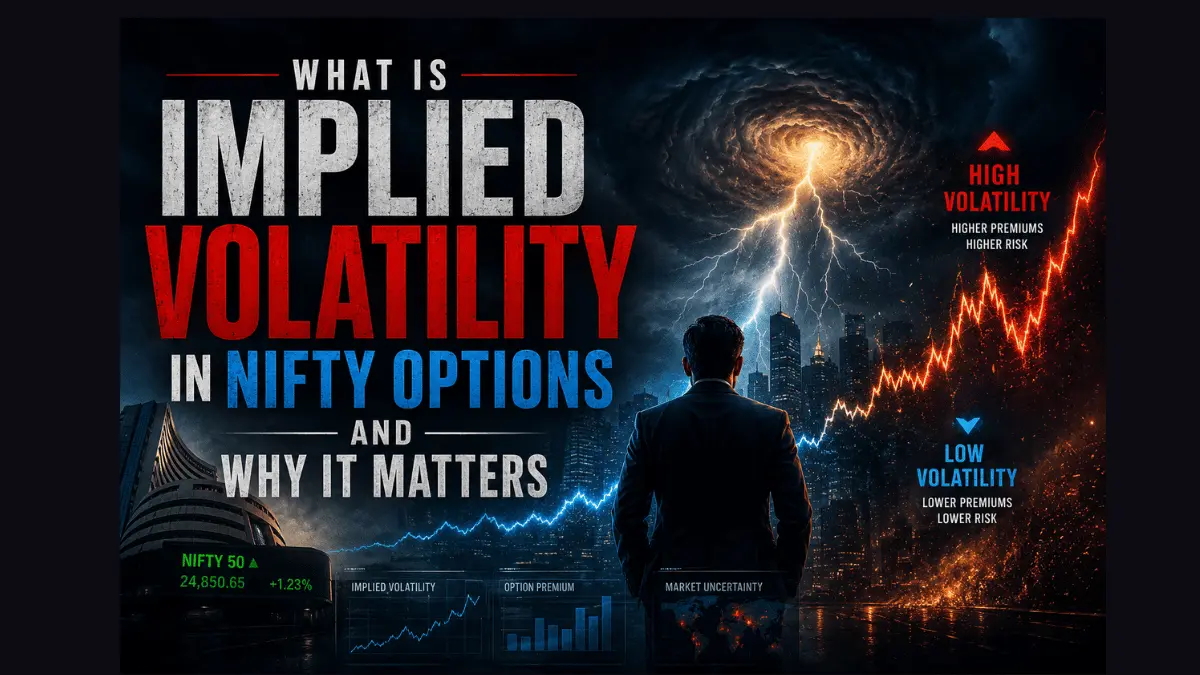
Implied volatility in Nifty options India is the single most important number in an option's price that most retail traders never look at. You can buy the right call option, watch Nifty move exactly where you predicted, and still lose money, because the implied volatility collapsed after you entered and took more premium out than the directional move added. Understanding implied volatility is what separates traders who wonder why they keep losing on correct calls from traders who understand the full pricing mechanics of every option they buy or sell. This article explains implied volatility in Nifty options from first principles: what it is, how it inflates and crushes premiums, how to measure it against its own history using IV Rank and IV Percentile, and how it shapes the statistical landscape for both buyers and sellers.
In This Article
- What Implied Volatility Actually Is
- Implied vs Historical Volatility: The Key Distinction
- How IV Directly Affects Nifty Option Premiums
- India VIX: The Market-Wide IV Gauge
- IV Crush: The Invisible Premium Drain After Events
- IV Rank and IV Percentile: Measuring IV Against Its Own History
- The IV Smile and Skew in Nifty Options
- IV for Buyers vs Sellers: The Statistical Landscape
- Using IV to Select Your Strategy
- A Practical IV Checklist Before Every Trade
What Implied Volatility Actually Is
Implied volatility is not something you observe directly in the market. It is something you calculate. Every option has a market price. Option pricing models, most commonly the Black-Scholes model, take a set of known inputs: the current Nifty level, the strike price, days to expiry, and the risk-free interest rate, and compute a theoretical option price given an assumed level of volatility. If you reverse this process and ask "what level of volatility would the model need to produce the option's current market price?" The answer to that question is implied volatility.
Put plainly: implied volatility in Nifty options is the market's collective expectation of how much Nifty will move, on an annualised basis, embedded in the current option price. It is not a prediction of direction. It is a measure of expected magnitude. When implied volatility is high, the market expects large swings. When it is low, the market expects calm. The premium you pay for any Nifty option is partly a function of this expectation.
Implied volatility is expressed as a percentage. A Nifty option with an implied volatility of 15% means the market is pricing in expected annual moves equivalent to 15% of the current Nifty level. To convert this to an expected daily move, divide by the square root of 252 (the approximate number of trading days in a year). At 15% IV and Nifty at 24,000, the expected daily one-standard-deviation move is approximately 15% divided by 15.87 (square root of 252), multiplied by 24,000, which equals roughly 227 Nifty points. At 25% IV, the same calculation gives approximately 378 points per day as a one-standard-deviation expected move.
Implied vs Historical Volatility: The Key Distinction
Implied volatility is forward-looking. It is the market's expectation of future movement. Historical volatility, also called realised volatility or statistical volatility, measures how much Nifty actually moved over a past period, typically the last 20 or 30 trading days. The relationship between these two numbers is one of the most strategically important comparisons in options trading.
When implied volatility is significantly higher than historical volatility, options are expensive relative to how much Nifty has actually been moving. The market is pricing in more expected movement than recent history justifies. This is often the environment before major events, or during risk-off periods when fear premium inflates IV. For option sellers, this represents a potential statistical edge: if the market keeps moving at its historical rate rather than the elevated implied rate, the premium they collected overestimates the actual risk.
When implied volatility is significantly lower than historical volatility, options are cheap relative to recent actual movement. The market is pricing in calmer conditions than Nifty has recently demonstrated. This is sometimes the environment after a long period of calm, before a volatility regime shift. For option buyers, low IV is generally more favourable than high IV because you are paying less for the same directional exposure.
How IV Directly Affects Nifty Option Premiums
Every option premium is composed of intrinsic value and time value, as covered in the Theta article in this Greeks series. Implied volatility directly inflates or deflates the time value component of every option premium. The Greek that measures exactly how sensitive an option's price is to a change in implied volatility is called Vega.
Understanding Vega
Vega is expressed as the rupee change in an option's premium per 1 percentage point change in implied volatility. If a Nifty ATM call has a Vega of 8, the option gains Rs 8 per unit (Rs 520 per lot at lot size 65) for every 1% increase in IV, and loses Rs 8 per unit for every 1% decrease. At India VIX of 14, if VIX spikes to 20 (a 6-point increase), that call gains Rs 48 per unit (Rs 3,120 per lot) purely from the IV expansion, before any Nifty movement is considered.
ATM options have the highest Vega of any strike. OTM options have lower but meaningful Vega. Deep ITM options have very low Vega because their price is dominated by intrinsic value, which is insensitive to IV. This means that when IV expands or contracts, ATM options are most affected in absolute rupee terms.
A concrete example: IV doubles
Suppose Nifty is at 24,000 and a weekly ATM call (24,000 CE) is trading at Rs 120 with India VIX at 13. An unexpected global event causes VIX to spike from 13 to 22 overnight. Nifty barely moves. The next morning, that same ATM call might trade at Rs 190 to Rs 210, purely from the IV expansion. You did not need Nifty to go anywhere. IV expansion alone added Rs 70 to Rs 90 per unit, or Rs 4,550 to Rs 5,850 per lot, to your position value. This is Vega working in the buyer's favour.
The same dynamic works against buyers. An ATM call bought at Rs 190 when VIX is 22 and then held through the event as VIX collapses to 13 loses Rs 70 to Rs 90 per unit from IV contraction alone, even if Nifty moves in the right direction.
India VIX: The Market-Wide IV Gauge
India VIX is the NSE's official implied volatility index for Nifty, calculated using a methodology similar to the CBOE VIX for the S&P 500. It represents the market's expectation of 30-calendar-day volatility, derived from the prices of Nifty options across a range of strikes and the two nearest expiry dates. India VIX is published free on the NSE website and is updated in near real-time during market hours.
The VIX zones that matter in practice
Below 12: Unusually calm. Options are very cheap. Historical periods of sub-12 VIX are often followed by volatility expansion. For option buyers, this represents one of the more attractive entry environments because premiums are depressed and any VIX expansion adds to position value through Vega. For sellers, sub-12 VIX means very low premium collected relative to the tail risk of a volatility spike.
12 to 16 (normal): The typical baseline range for Nifty in calm market conditions. Options are fairly priced relative to recent historical movement. No strong edge for either buyers or sellers from the IV level alone.
16 to 22 (elevated): Premiums are meaningfully above the normal range. Often occurs ahead of events, during periods of sustained uncertainty, or after a moderate selloff. Selling becomes incrementally more attractive from a statistical edge standpoint. Buying costs more and carries higher IV crush risk.
Above 22 (high): Options are expensive. This typically occurs during significant market events, sharp corrections, or global stress episodes. The statistical edge for option sellers increases substantially in this zone, though the reason VIX is high (i.e., the event or risk that is causing it) also means the tail risks are genuinely larger. Buying in this zone is expensive and carries maximum IV crush exposure.
Above 30 (extreme): Rare but significant. India VIX touched 85 during the March 2020 COVID crash and spiked above 30 during the 2024 election result session. At extreme VIX levels, option prices reflect very large expected moves and the IV crush after resolution is equally extreme. Buying extreme-VIX options requires a very large move to overcome the subsequent collapse.
IV Crush: The Invisible Premium Drain After Events
IV crush is what happens when implied volatility collapses after a major scheduled event, and it is the mechanism behind one of the most frustrating experiences in options trading: being right about direction and still losing money.
The sequence is straightforward. Before a major event, uncertainty pushes IV up and inflates premiums. A Nifty ATM call that was worth Rs 120 in normal conditions might be worth Rs 200 the day before a Budget announcement, because the Rs 80 of extra premium reflects the event uncertainty. After the Budget is announced, the uncertainty resolves. Even if Nifty moves 300 points in the direction you predicted, the IV component of your premium falls sharply. The directional gain from delta adds to your premium. The IV collapse from Vega subtracts from it. If the IV collapse is larger than the delta gain, you lose money on a correct directional trade.
How to avoid IV crush damage as a buyer
The cleanest way to manage IV crush exposure is to exit options positions before the event resolves rather than holding through the announcement. If you buy a Nifty call three days before an RBI announcement because you expect a rally, exit your position on the day of the announcement, before the decision is released, while the IV premium is still in the option. You capture the IV expansion gain (premiums have risen into the event) without needing the directional move to pay off. This approach is covered in depth in the NiftyWise exit strategy guide.
IV Rank and IV Percentile: Measuring IV Against Its Own History
Knowing that India VIX is at 18 tells you the absolute IV level. But it does not tell you whether 18 is cheap or expensive relative to what VIX has been doing over the past year. To know that, you need IV Rank or IV Percentile. These are two of the most practically useful tools in options trading and they are systematically underused by retail traders in India.
IV Rank (IVR)
IV Rank answers this question: where does today's IV sit within the range of IV over the past 52 weeks? The formula is:
IVR = (Current IV - 52-week low IV) / (52-week high IV - 52-week low IV) x 100
If India VIX had a 52-week low of 11 and a 52-week high of 28, and today VIX is at 18, the IVR is (18 - 11) / (28 - 11) x 100, which equals 41. An IVR of 41 means current IV is in the lower-middle of its annual range, not particularly cheap or expensive.
An IVR above 50 means IV is in the upper half of its annual range. Above 75 is considered high IV by most practitioners. Below 25 is considered low IV. The scale is intuitive: 0 = at the annual low, 100 = at the annual high.
IV Percentile (IVP)
IV Percentile answers a slightly different question: on what percentage of the past 252 trading days was IV lower than it is today? The formula counts, out of 252 historical sessions, how many had IV below today's level, then divides by 252 and multiplies by 100.
If IV was below today's level on 180 of the past 252 sessions, the IVP is 71. This means today's IV is higher than 71% of recent days, which is moderately elevated from a historical frequency perspective.
IVP is generally considered more robust than IVR because IVR is sensitive to outlier spikes. If VIX briefly touched 30 during a one-day crisis and has since returned to 14, the IVR might show 40 (appears moderate) while the IVP might show 20 (appears cheap, which is more accurate for typical conditions). IVP reflects frequency of occurrence, which is more meaningful for most option strategies.
What IVR and IVP tell you in practice
IVR or IVP above 75: IV is historically elevated. Options are expensive. Selling strategies (covered calls, cash-secured puts, short spreads) have a statistical edge. Buyers are paying above-average premiums and need a larger-than-average move to profit.
IVR or IVP below 25: IV is historically cheap. Options are inexpensive. Buying strategies (long calls, puts, or long straddles) are relatively more attractive because you are paying below-average premiums. Selling provides below-average premium income that may not adequately compensate for risk.
IVR or IVP between 25 and 75: IV is in the middle of its historical range. No strong IV-based edge for either side. Other factors (trend, OI structure, technical levels) should dominate the strategy decision.
The IV Smile and Skew in Nifty Options
Implied volatility is not uniform across all strikes in the Nifty option chain. If you look at the IV column in the option chain, you will notice that OTM puts consistently show higher IV than equidistant OTM calls, and that ATM options often have the lowest IV across the chain. This pattern is called the volatility skew, and in index options like Nifty it is persistent and structurally important.
The reason for the skew is institutional demand. Large funds holding equity portfolios buy OTM put options as insurance against sharp market falls. This persistent demand inflates the IV of OTM puts relative to equidistant OTM calls. The market essentially charges a premium for downside protection that is not symmetrically charged for upside speculation. This skew exists in all major equity index options globally and has been persistent in Nifty options for as long as systematic options data has existed.
What this means practically: if you buy an OTM Nifty put at a given IV, you are paying a higher volatility premium relative to the OTM call at the same distance. Buying the OTM put at a skew-inflated IV and then seeing that IV normalise means IV works against you from two directions: general IV collapse plus skew normalisation. For sellers, the opposite applies: selling OTM puts in a high-skew environment provides premium that is inflated by the skew, giving an additional margin of safety compared to selling equidistant calls.
IV for Buyers vs Sellers: The Statistical Landscape
The relationship between IV and strategy selection is one of the most consistently cited edges in systematic options trading, and it applies with real force to Nifty options given India VIX's well-documented tendency to mean-revert.
When IV is high: sellers have a statistical edge
When IVP or IVR is above 75, historical data across most option markets shows that implied volatility tends to overstate subsequent realised volatility. The market's fear premium is greater than the actual movement that follows. Option sellers who collect premium when it is at elevated IV levels are, on average, collecting more premium than the actual risk of adverse movement justifies. This is the statistical basis for the recommendation that high-IV environments favour selling strategies.
For Nifty specifically: when India VIX is above 22 and IVP is above 75, selling defined-risk spreads (bull put spreads, bear call spreads, iron condors) statistically captures above-average premium relative to the risk. The defined-risk structure is essential because unlimited-loss naked selling in any high-VIX environment carries real tail risk from the very events that are causing the elevated VIX.
When IV is low: buyers have a relatively better entry
When IVP is below 25, buyers are paying below-average premiums for the same directional exposure. This does not mean low-IV environments produce profitable option buying; it means the structural headwind of overpaying for IV is reduced. Buying ATM options when IVP is below 25 and VIX is at 11 or 12 means paying a low volatility premium, which reduces the IV crush risk and makes the trade's profitability more purely dependent on the directional move rather than on beating a high IV hurdle.
Using IV to Select Your Strategy
IV level and IV percentile together form one of the most reliable filters for matching your strategy to current market conditions. The table below summarises the general framework that experienced options traders use.
| Market condition | IVP / IVR | India VIX | Strategies with edge | Strategies to avoid |
|---|---|---|---|---|
| Low IV | Below 25 | Below 13 | Buying calls / puts, Long straddles (event plays) | Short straddles, naked selling |
| Normal IV | 25 to 75 | 13 to 18 | Directional spreads, defined-risk trades | No strong IV-based reason to favour either side |
| Elevated IV | 50 to 75 | 18 to 22 | Defined-risk selling: spreads, iron condors | Buying naked calls / puts (IV crush risk) |
| High IV | Above 75 | Above 22 | Defined-risk selling (experienced traders). Exit buying positions before resolution. | Buying expensive options and holding through event. Naked selling without experience. |
Strategy suggestions are general educational frameworks, not trading recommendations. Actual strategy selection must account for your capital, experience, market view, and risk tolerance. All F&O trading involves substantial risk of loss.
A Practical IV Checklist Before Every Trade
This checklist takes under two minutes before any Nifty options trade and ensures you are never entering a position without understanding the IV environment.
Check 1: What is India VIX right now? Is it in the normal range (12 to 16), elevated (16 to 22), or high (above 22)? Available free on nseindia.com or in your broker's dashboard. TradeSmart's home screen shows the Nifty level; VIX is one tab away on NSE.
Check 2: What is the IVP of the specific option you are considering? Most options analytics platforms display IVP. An IVP above 75 signals expensive options; below 25 signals cheap. This is the single most important pre-trade IV check.
Check 3: Is there a major event in the next 48 hours? RBI announcement, Budget, election results, significant global data? If yes, any option you buy already has event IV premium baked in. Decide before entry whether you plan to exit before the event (capture IV expansion without event risk) or hold through (accept IV crush risk in exchange for potential directional payoff).
Check 4: Is IV rising or falling? If VIX is rising as you consider buying, that is a tailwind (Vega works for you if IV continues rising). If VIX is falling as you consider buying, that is a headwind (IV contraction will drain premium even before direction pays off).
Check 5: How does the current IV compare to the option's Vega? If the option has a Vega of 10 and IV is likely to fall by 3 points after the event, that is Rs 30 per unit (Rs 1,950 per lot) of likely Vega loss. Does your expected directional gain from Nifty's move exceed this? If Nifty is expected to move 100 points and the option has a delta of 0.5, the delta gain is Rs 50 per unit. Delta gain (Rs 50) minus Vega loss (Rs 30) is a net Rs 20 gain per unit. Without this check, many traders enter event trades expecting full directional payoff and are blindsided by the Vega drain.
🎯 Implied volatility in Nifty options: the short version
- What IV is: The level of volatility implied by the current market price of an option, derived by back-solving the Black-Scholes model. It is the market's expectation of future Nifty movement magnitude, not direction. Higher IV means more expensive options regardless of strike.
- Vega: The Greek that measures how much an option's premium changes per 1% change in IV. ATM options have the highest Vega. A Vega of 8 means Rs 8 per unit gain or loss for every 1% IV move. At lot size 65, that is Rs 520 per lot per 1% IV change.
- India VIX: NSE's real-time 30-day IV index for Nifty. Normal range 12 to 16. Above 22 is high. Above 30 is extreme. Available free on nseindia.com.
- IV crush: The sharp collapse in IV after a major event resolves, which removes the event uncertainty premium from all option prices simultaneously. Buyers holding through events can lose money on correct directional calls if IV crush exceeds the delta gain. Exit before the event resolves to capture IV expansion without IV crush risk.
- IVR vs IVP: IV Rank measures where current IV sits in the 52-week range. IV Percentile measures on what percentage of recent days IV was lower than today. IVP is more robust to outlier spikes and gives a more accurate read of whether IV is truly high or low relative to typical conditions.
- IV Percentile above 75: Options are historically expensive. Selling strategies have a statistical edge. IV crush risk is highest for buyers. IV Percentile below 25: Options are historically cheap. Buying is relatively more attractive. Sellers collect below-average premium.
- IV skew: OTM puts in Nifty options consistently carry higher IV than equidistant OTM calls, driven by persistent institutional hedging demand. Buyers of OTM puts pay a skew premium on top of the base IV cost.
Frequently Asked Questions
What is implied volatility in Nifty options?
Implied volatility in Nifty options is the level of expected future price movement that is embedded in an option's current market price, derived by working backwards from the price through an options pricing model such as Black-Scholes. It is expressed as an annualised percentage. A Nifty ATM option with an implied volatility of 15% reflects the market's expectation that Nifty will move at an annualised rate of approximately 15% of its current level. Higher implied volatility means more expensive option premiums for both calls and puts at all strikes. India VIX, published by NSE, is the market-wide 30-day implied volatility gauge for Nifty and is available free at nseindia.com.
What is IV crush and how does it affect option buyers?
IV crush is the sharp decline in implied volatility that occurs immediately after a major scheduled event, such as an RBI announcement, Union Budget, or election result, once the uncertainty that inflated IV resolves. Before the event, option premiums are elevated by an uncertainty premium. After the event, this premium collapses even if Nifty makes a large move. For option buyers, IV crush can produce a situation where the option loses more in IV premium than it gains from the directional movement in Nifty. The practical defence is to exit option positions before the event resolves rather than holding through the announcement, capturing the IV expansion without being exposed to the subsequent IV crush.
What is IV Rank and IV Percentile, and which is better?
IV Rank (IVR) measures where today's implied volatility sits within the 52-week high-to-low range, expressed as a percentage. IV Percentile (IVP) counts on what percentage of the past 252 trading days the implied volatility was lower than today's level. IV Percentile is generally considered more accurate because IVR is distorted by extreme outlier spikes in the 52-week range. A single day where India VIX touched 30 during a crisis can make IVR show 15 (cheap) when VIX is now at 14, while IVP might correctly show 80 (expensive), because most regular sessions had lower VIX. Most professional options traders prefer IVP as the primary IV context measure.
When is it better to buy options and when is it better to sell them in terms of IV?
As a general educational framework: when IV Percentile is below 25, options are historically cheap and buying is relatively more attractive because you are paying a lower volatility premium. When IV Percentile is above 75, options are historically expensive and selling strategies (especially defined-risk spreads) have a statistical edge because the premium collected tends to overstate the subsequent actual movement. Between 25 and 75, no strong IV-based edge exists for either side and other factors should dominate the strategy decision. These are general frameworks, not trading recommendations. Option selling requires substantially more capital, experience, and risk management than buying regardless of IV level.
Why is the India VIX important for Nifty options traders?
India VIX is the NSE's real-time measure of 30-day expected volatility for Nifty, derived from current option prices. It is important because it tells you the overall IV regime your trade is entering. A trade entered at VIX 12 has very different risk and reward characteristics from the same trade entered at VIX 25, even if all other factors are identical. High VIX means more expensive premiums, higher IV crush risk for buyers, larger potential gains from VIX expansion, and a statistical edge for sellers. Low VIX means cheaper premiums, lower IV crush risk, smaller Vega sensitivity, and below-average premium income for sellers. Checking India VIX before every trade is a basic but powerful pre-trade discipline.
What is the volatility skew in Nifty options?
The volatility skew in Nifty options refers to the consistent pattern where out-of-the-money put options have higher implied volatility than equidistant out-of-the-money call options. For example, a Nifty put option 200 points below the current market might have an IV of 18%, while a call option 200 points above might have an IV of 14%, even though they are at equal distance from the current level. This skew is driven by persistent institutional demand for downside protection through put buying, which inflates OTM put premiums. The practical implication is that OTM put buyers pay a skew premium on top of the base IV, making OTM puts relatively more expensive than their equidistant OTM call counterparts.
Ready to Trade Live? Start with the Lowest Brokerage in India
Once you understand IV and the option chain, execution cost matters. TradeSmart charges just Rs 15 per executed order (Power Plan) or Rs 7 per lot on options (Value Plan), the lowest brokerage at any SEBI-registered broker in India, across equity, F&O, currency, and commodity segments.
Beyond cost, TradeSmart offers real human support reachable by phone and WhatsApp during market hours with response times under five to fifteen minutes. When you have a question about a live IV-driven position moving against you, that accessibility matters.
This is not a paid promotion. The author may earn a commission if you open an account with TradeSmart through the link below. This does not affect editorial independence.
Open a Free TradeSmart Demat Account →⚠️ Disclaimer: Please Read. This article is written by Feroz Omar and published on NiftyWise.org for educational and informational purposes only. Nothing in this article constitutes investment advice, a trading recommendation, or a solicitation to trade in any financial instrument. This is not a paid promotion. The author may earn a commission if you open an account with TradeSmart through links in this article; this does not affect editorial independence. All implied volatility values, Vega estimates, IV Rank and IV Percentile calculations, and premium figures used are approximate and for illustrative purposes only. Actual implied volatility, Vega, and option premiums vary continuously with market conditions. The strategy framework table is a general educational reference and does not constitute specific trading advice. Trading in F&O involves substantial risk of loss and is not suitable for all investors. As per SEBI's study (July 2025): 91% of individual traders in the equity F&O segment incurred net losses in FY2024-25, with aggregate retail losses of Rs 1.05 lakh crore. Nifty 50 lot size of 65 units is effective from January 2026 per NSE circular FAOP70616. Nifty weekly expiry on Tuesday is effective from September 2, 2025. NiftyWise.org is an educational platform and is not registered with SEBI as an Investment Adviser, Research Analyst, or Stockbroker. Please consult a SEBI-registered Investment Adviser before making any trading or investment decisions. Visit sebi.gov.in for a list of registered advisers.