Options Education · Beginner
Call Option vs Put Option in Nifty: A Beginner's Complete Guide(2026)
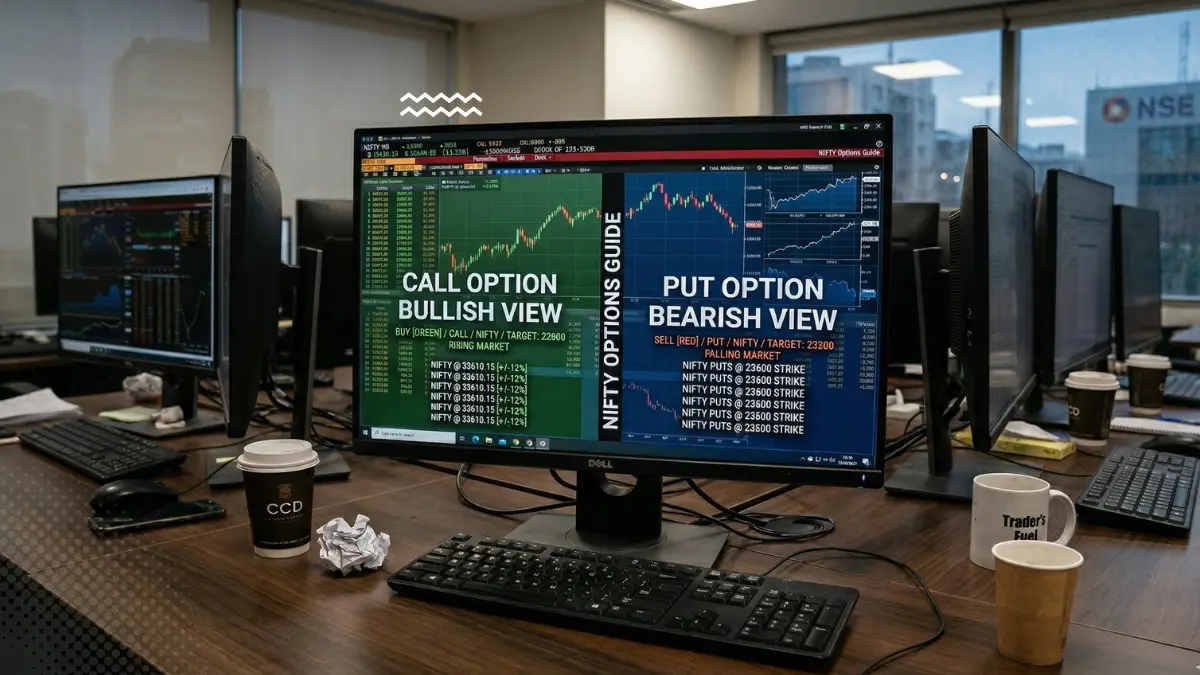
Every Nifty options trade starts with a single choice: CE or PE. Call or Put. You are either betting that Nifty will rise above a certain level, or betting that it will fall below one. Get this foundational choice right and everything else in options trading becomes clearer. Get it wrong and no strategy, no analysis, and no indicator will save you. This guide explains exactly what calls and puts are, how they pay off, how to calculate breakeven and profit, and when to use each one. Real current Nifty numbers throughout.
In This Article
- What Is a Call Option (CE) in Nifty
- What Is a Put Option (PE) in Nifty
- Payoff Explained: How Profit and Loss Work on Each
- Breakeven Points: What Nifty Must Do for You to Profit
- Call vs Put: The Side-by-Side Comparison
- When to Use a Call and When to Use a Put
- Transaction Costs You Need to Know
- Three Things That Confuse Most Beginners
What Is a Call Option (CE) in Nifty
A call option gives you the right, but not the obligation, to benefit from Nifty rising above a specific price (the strike price) before a specific date (expiry). You pay a premium upfront to acquire this right. If Nifty rises past your strike, the option becomes valuable. If it does not, you lose the premium you paid. That is your maximum loss: what you paid.
On NSE, call options are labelled CE, which stands for Call European. The "European" part means you cannot exercise the option early. Settlement happens automatically at expiry on Tuesday, based on the average Nifty level during the final 30 minutes of trading (3:00 PM to 3:30 PM).
Think of a call option like this. Say Nifty is at 23,200 today. You think it will rally to 23,600 in the next few days. You do not want to trade Nifty futures because that requires much more capital and carries unlimited loss risk. Instead, you buy a 23,200 CE (an ATM call) for ₹180. Your total investment is ₹180 x 65 (lot size) = ₹11,700. If Nifty rallies to 23,600 by expiry, your call is worth at least ₹400. You make a profit. If Nifty stays flat or falls, your call expires worthless and you lose ₹11,700. Not ₹50,000. Not everything. Just the premium you paid.
What Is a Put Option (PE) in Nifty
A put option is the opposite of a call. It gives you the right to benefit from Nifty falling below a specific strike price before expiry. You pay a premium. If Nifty falls past your strike, the option becomes valuable. If Nifty stays above your strike, the option expires worthless and you lose the premium.
On NSE, put options are labelled PE, which stands for Put European. Same European settlement rules apply: settlement is automatic at expiry based on the final 30-minute average Nifty value.
A put option is also used as insurance. If you have Nifty futures positions or a portfolio of Nifty-correlated stocks and you are worried about a sharp fall, buying a put gives you protection. Right now in March 2026, with the Iran war driving Nifty lower and India VIX near 22, many traders who held Nifty put options through the falls have been well-served by that protection. Buying a put earlier would have offset portfolio losses significantly.
Payoff Explained: How Profit and Loss Work on Each
Let me walk through the complete payoff for both, using a single consistent example so the comparison is direct.
Nifty is at 23,200. You buy one lot of the 23,200 CE (ATM call) for a premium of ₹180. Total cost: ₹11,700.
Call option payoff at various Nifty settlement levels
| Nifty at expiry | Option value (intrinsic) | P&L per lot (before costs) | Outcome |
|---|---|---|---|
| 22,800 (fell 400) | ₹0 (OTM, worthless) | -₹11,700 | Maximum loss. Full premium gone. |
| 23,000 (fell 200) | ₹0 (still OTM) | -₹11,700 | Maximum loss. Still OTM. |
| 23,200 (flat) | ₹0 (exactly ATM) | -₹11,700 | Maximum loss. Flat market hurts call buyers. |
| 23,380 (up 180) | ₹180 (just ITM) | ₹0 | Breakeven exactly. Recovered premium. |
| 23,500 (up 300) | ₹300 | +₹7,800 | Profit of ₹7,800 (300-180 = 120 pts x 65). |
| 23,800 (up 600) | ₹600 | +₹27,300 | Profit of ₹27,300 (600-180 = 420 pts x 65). |
Now the same analysis for a put. Nifty is at 23,200. You buy one lot of the 23,200 PE (ATM put) for ₹170. Total cost: ₹11,050.
Put option payoff at various Nifty settlement levels
| Nifty at expiry | Option value (intrinsic) | P&L per lot (before costs) | Outcome |
|---|---|---|---|
| 23,600 (rose 400) | ₹0 (OTM, worthless) | -₹11,050 | Maximum loss. Rising market hurts put buyers. |
| 23,200 (flat) | ₹0 (exactly ATM) | -₹11,050 | Maximum loss. No movement means no put profit. |
| 23,030 (down 170) | ₹170 (just ITM) | ₹0 | Breakeven. Recovered the ₹170 premium paid. |
| 22,900 (down 300) | ₹300 | +₹8,450 | Profit of ₹8,450 (300-170 = 130 pts x 65). |
| 22,500 (down 700) | ₹700 | +₹34,450 | Profit of ₹34,450 (700-170 = 530 pts x 65). |
All figures use Nifty lot size of 65 (effective January 2026 per NSE circular). Premiums are approximate and for illustration only. Actual premiums vary with VIX, time to expiry, and market conditions. P&L figures are before transaction costs.
Practice Buying Calls and Puts in Real Nifty Scenarios. For Free.
NiftyWise's simulator lets you trade both CE and PE options through historical Nifty events. Watch how each responds to market moves. ₹10 lakh virtual capital. Zero real money.
Launch Free Simulator →Breakeven Points: What Nifty Must Do for You to Profit
Breakeven is the exact Nifty level where your option trade produces zero profit and zero loss at expiry. Below breakeven, you are in loss. Above it, you are in profit. Every options trader should calculate this before entering any trade.
The formulas are straightforward.
Breakeven = 23,200 + 180 = 23,380.
Nifty must close above 23,380 at expiry for any profit.
Breakeven = 23,200 - 170 = 23,030.
Nifty must close below 23,030 at expiry for any profit.
These formulas assume you hold the option to expiry. Many market participants choose to exit before expiry to avoid settlement-related uncertainties. If you exit before expiry (which most traders should), your actual breakeven is different because the option still carries time value that can be sold. Selling an option before expiry when it has moved partially in your favour, even if not yet past the theoretical breakeven, is often the better decision than waiting.
Call vs Put: The Side-by-Side Comparison
| Feature | Call Option (CE) | Put Option (PE) |
|---|---|---|
| Market view needed | Bullish. You expect Nifty to rise. | Bearish. You expect Nifty to fall. |
| You buy when | Nifty is expected to move above your strike before expiry. | Nifty is expected to move below your strike before expiry. |
| Profit condition | Nifty closes above (strike + premium paid) at expiry. | Nifty closes below (strike - premium paid) at expiry. |
| Maximum profit | Unlimited, in theory. Every point above breakeven adds profit. | Capped (Nifty cannot go below zero, though practically very large). |
| Maximum loss | Limited to premium paid. If flat or falls: lose ₹11,700 on ₹180 ATM call. | Limited to premium paid. If flat or rises: lose ₹11,050 on ₹170 ATM put. |
| Flat market effect | Bad. Theta eats premium daily. Flat = loss for call buyers. | Bad. Theta eats premium daily. Flat = loss for put buyers. |
| NSE label | CE (Call European) | PE (Put European) |
| Settlement | European-style. Cash-settled at expiry (3:00–3:30 PM average). No physical delivery. | European-style. Cash-settled at expiry. Same rules. |
| Use case | Bullish directional bet. Event-driven rally trades. Capitalise on rising markets. | Bearish directional bet. Portfolio hedge. Capitalise on falling markets or events. |
"Most beginners think about calls when Nifty is rising and puts when it is falling. That is the right instinct. The mistake is forgetting that both options are bleeding premium from theta every single day, regardless of direction. The market does not pay you for waiting."
When to Use a Call and When to Use a Put
The choice between CE and PE should follow your market view. Here are the real-world situations where each one makes sense.
Buy a Call (CE) when:
- You expect Nifty to rise. A positive macro event like an RBI rate cut, a strong Budget, or a global risk-on day makes calls the natural vehicle.
- You want to benefit from a market recovery after an oversold fall. Right now in March 2026, traders who believe the Iran war will resolve quickly and Nifty will bounce back from its current 23,200 level toward 24,500 to 25,000 are buyers of calls.
- You are neutral but want to defined-risk leverage on an upcoming bullish catalyst. A small premium outlay on a call costs far less than futures margin and limits your downside to the premium.
Buy a Put (PE) when:
- You expect Nifty to fall. A negative event, rising crude oil prices, FII selling pressure, or a global risk-off day makes puts the natural choice.
- You want to hedge an existing portfolio. If you hold Nifty-correlated stocks and fear a sharp selloff, buying puts lets you keep your long positions while adding downside protection.
- Uncertainty is rising before a known event. Before Budget Day or election results, buying puts alongside calls (a straddle) allows you to profit regardless of direction, because one of the two will likely pay off significantly.
What the current market says (March 2026)
With India VIX at 22 and the Iran war ongoing, Nifty has been range-bound and volatile. Both calls and puts are expensive because of elevated implied volatility. Call buyers are paying high premiums hoping for a peace signal that drives a relief rally. Put buyers are paying high premiums expecting further geopolitical deterioration to push Nifty lower. Both are valid views. Neither is cheap. In this environment, buying either direction requires a stronger conviction than usual because the inflated premium means you need a larger move just to break even.
Transaction Costs You Need to Know
Every Nifty options trade carries costs beyond the premium. Most new traders ignore these until they realise they are eating into profits on every trade. Here is what applies.
| Cost | Who pays | Rate (as of March 2026) | Note |
|---|---|---|---|
| STT (Securities Transaction Tax) | Seller of option (on sell leg) | 0.05% of premium turnover (as per Budget 2026 proposal, subject to final notification) | Rising to 0.15% from April 1, 2026 per Budget 2026. Exercise STT applies on ITM options at settlement. |
| NSE transaction charges | Both buyer and seller | 0.05% of premium value | Applied on both legs of the trade. |
| GST | Both | 18% on (brokerage + transaction charges) | Charged on the service fee component, not on premium. |
| Brokerage | Both | ₹20 per executed order (discount brokers) | Flat fee model. Varies by broker. Full-service brokers charge more. |
| Stamp duty | Buyer | 0.002% of contract value | State-specific. Maharashtra rate cited here. |
For most small retail trades on one or two lots, these costs are relatively minor individually. But they matter when you trade frequently. SEBI found that average F&O traders spent ₹26,000 in transaction costs in FY24 alone. Over three years, the collective transaction cost bill across all retail traders was ₹50,000 crore. That is money paid to the system before a single trade even becomes profitable.
Three Things That Confuse Most Beginners
Confusion 1: "A call means I'm buying something and a put means I'm selling"
No. When you buy a call or a put, you are a buyer in both cases. You pay a premium. You receive the right. The call gives you the right to benefit from Nifty rising. The put gives you the right to benefit from Nifty falling. Both are buying actions. The terminology "put" does not mean you are selling anything when you buy a put option.
Confusion 2: "Selling a call means I'm bearish"
Not always. This one is more nuanced. Selling a call means you are collecting premium and betting that Nifty will not rise above your strike. That is directionally neutral-to-bearish. But selling a call as part of a covered call strategy (where you own Nifty futures and sell a call above to collect premium) is actually a bullish-to-neutral position. The moneyness and context of the sell matter. For beginners, stick to buying calls and puts before exploring selling strategies.
Confusion 3: "If Nifty moves in my direction, I always make money"
Unfortunately, no. You can buy a call, Nifty can rise 100 points, and your option can still lose value. How? If implied volatility fell after you bought (IV crush), the option's time value component compresses even as delta adds value from the directional move. If the move was slow and theta eroded more premium than delta added, you lose. This is the most important misunderstanding new options traders carry. Direction is necessary but not sufficient for profit. Speed of the move, time remaining, and VIX level all matter simultaneously.
🎯 Call option vs put option in Nifty: the short version
- CE (Call European) gives you the right to benefit from Nifty rising above your strike. You are bullish when you buy a call.
- PE (Put European) gives you the right to benefit from Nifty falling below your strike. You are bearish when you buy a put.
- For both: maximum loss is the premium paid. Maximum profit is large (calls: unlimited; puts: very large but capped at Nifty going to zero). Both are European-style and cash-settled on NSE.
- Breakeven for a call = strike + premium paid. Breakeven for a put = strike - premium paid. Calculate this before entering any trade.
- Both calls and puts lose value every day from theta, regardless of Nifty's direction. A flat market hurts buyers of both CE and PE equally.
- Nifty lot size is 65 from January 2026. Every premium calculation multiplies by 65. The previous lot size was 75.
- Weekly Nifty options expire every Tuesday, effective September 2, 2025. Settlement uses the average Nifty level during the final 30 minutes (3:00 to 3:30 PM).
- STT on options (sell side) is currently 0.05% of premium, rising to 0.15% from April 1, 2026 per Budget 2026. Factor this into trade cost calculations.
- Buying puts after a large fall or buying calls after a large rally usually means buying expensive implied volatility. Option premiums often increase after large moves due to higher implied volatility.
Frequently Asked Questions
What is the difference between CE and PE in Nifty options?
CE stands for Call European and PE stands for Put European. Both are Nifty index options traded on NSE. CE is a call option: you buy it when you expect Nifty to rise, and it profits when Nifty closes above your strike plus the premium paid at expiry. PE is a put option: you buy it when you expect Nifty to fall, and it profits when Nifty closes below your strike minus the premium paid. Both are European-style options, meaning settlement happens only at expiry, not before. Both are cash-settled: no physical delivery of stocks occurs.
Can I lose more than what I paid for a Nifty call or put?
No. When you buy a Nifty call or put, your maximum loss is strictly limited to the premium you paid. If you paid ₹11,700 for one lot of a call option, the worst that can happen is you lose ₹11,700. This is one of the defining advantages of buying options versus trading futures. Futures have potentially unlimited loss. Options do not. This is why options are often described as limited-risk, unlimited-reward (for calls) or limited-risk, large-reward (for puts) instruments.
How is Nifty options profit calculated?
For a call option held to expiry: profit per lot = (Nifty settlement price - strike price - premium paid) x lot size. For a put option held to expiry: profit per lot = (strike price - Nifty settlement price - premium paid) x lot size. If the result is negative, you lose only the premium paid (loss is capped at the premium). If you exit before expiry, profit = (selling price - buying price) x lot size. Nifty lot size is currently 65 units per contract. Always subtract transaction costs (brokerage, STT, GST) from the gross profit figure to get your net profit.
Should a beginner start with calls or puts?
Start with whichever matches your view on Nifty's near-term direction. Practically, many beginners find calls slightly more intuitive because bullish trades on a rising market feel natural. However, the mechanics of calls and puts are identical: same premium structure, same theta decay, same breakeven calculation logic. One is not safer than the other. Both lose money in a flat market. Both require Nifty to move decisively in your direction before expiry for you to profit. Focus on understanding theta, VIX, and breakeven calculation before worrying about whether to start with calls or puts.
What happens to my call or put if I don't sell it before expiry?
If you hold to expiry, settlement is automatic. If your option is in the money at the final settlement price (the 30-minute average of Nifty from 3:00 to 3:30 PM on Tuesday), you receive the intrinsic value in cash automatically. No action needed. If your option is out of the money at settlement, it expires worthless and you lose the premium you paid. No action needed for that either. Most experienced traders do not hold to expiry for near-ATM positions because the 30-minute average settlement introduces uncertainty about the final number. Exiting before 2:30 PM on expiry day gives you a known, certain exit price.
Try Buying Calls and Puts in Real Nifty Scenarios. Zero Real Money.
NiftyWise's free simulator gives you ₹10 lakh virtual capital to trade CE and PE options through real historical Nifty events. See how each behaves across different market conditions.
Launch Free Simulator →⚠️ Disclaimer: Please Read. This article represents the personal opinions and analysis of the NiftyWise editorial team. It is for educational purposes only and does not constitute investment advice, a trading recommendation, or financial guidance of any kind. The reviewer has no financial interest in the platform mentioned. Reviewed from a financial literacy and compliance perspective .No endorsement of any platform is intended. All premium, breakeven, and P&L figures are approximate and for illustration only. Actual values vary with VIX, time to expiry, and market conditions. Nifty lot size of 65 is effective from January 2026 per NSE circular FAOP70616. Nifty weekly expiry on Tuesday is effective from September 2, 2025, per NSE circular (June 2025). STT rates cited are current as of March 2026; the proposed increase to 0.15% applies from April 1, 2026, per Budget 2026 proposal subject to final gazette notification. All Nifty index options are European-style and cash-settled per NSE contract specifications. SEBI ₹26,000 average transaction cost figure and 93% loss rate are from SEBI's updated study published September 2024 (FY22 to FY24). NiftyWise is not registered with SEBI as an Investment Adviser, Research Analyst, or Stockbroker. Past performance, simulated or actual, is not indicative of future results. Options trading carries substantial risk. As per SEBI's updated study (September 2024): 93% of individual traders in the equity F&O segment incurred losses between FY22 and FY24. Please consult a SEBI-registered Investment Adviser before making any investment decisions. Visit sebi.gov.in for a list of registered advisers.