Options Education · Beginner
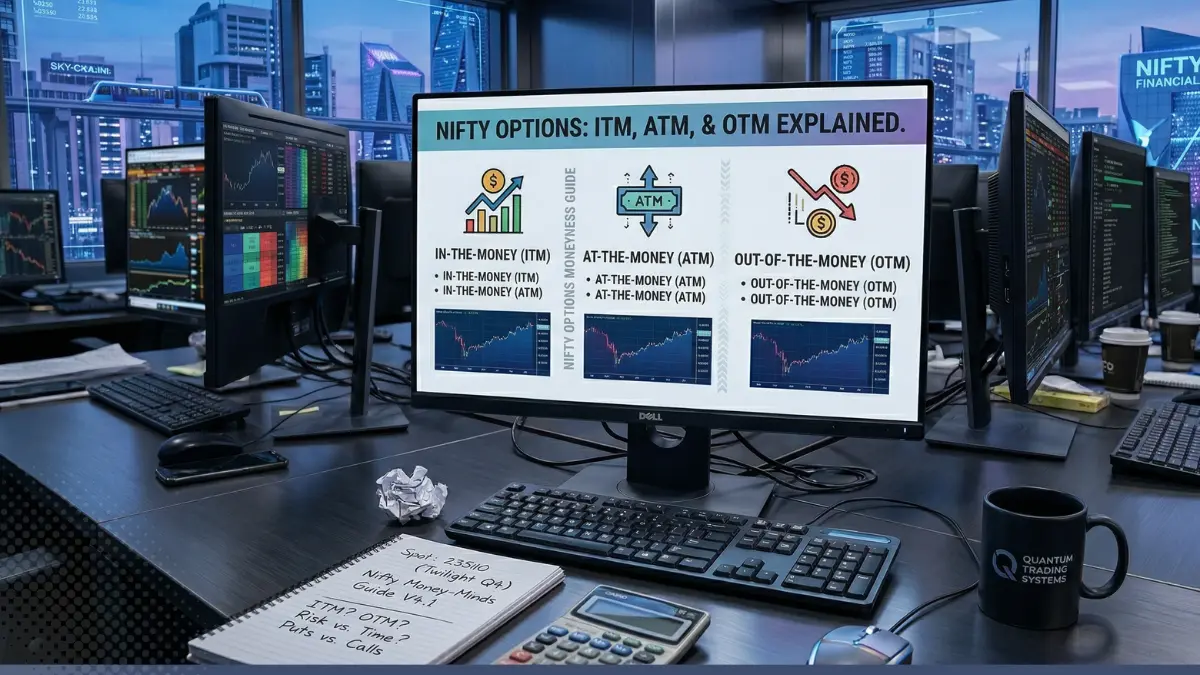
ITM, ATM, and OTM in Nifty Options: What They Mean and Why They Matter
Every time you open the Nifty option chain you see hundreds of strike prices running down the middle of the screen. Some are highlighted. Most are not. Some have fat premiums. Others cost ₹5. The difference between all of these is not random. It comes down to one concept: where the strike sits relative to where Nifty is currently trading. ITM, ATM, and OTM are the three zones that tell you exactly that. Get them wrong when you pick a strike and you can be completely right about Nifty's direction and still lose money. Get them right and you understand half of what options trading is actually about.
In This Article
- What Moneyness Means in Options
- In the Money (ITM): The Option Already Has Real Value
- At the Money (ATM): The Most Active Strike on the Board
- Out of the Money (OTM): Entirely Dependent on a Future Move
- ITM vs ATM vs OTM: The Side-by-Side Comparison
- How Moneyness Links to Delta
- Which One Should You Actually Buy?
- What Happens at Expiry
What Moneyness Means in Options
Moneyness is simply the relationship between an option's strike price and the current spot price of Nifty. It tells you one fundamental thing: if you exercised this option right now, would you make money or not?
That answer depends entirely on two numbers. The strike price, which is fixed when you buy the option and never changes. And the spot price of Nifty, which changes every second during market hours. The relationship between these two determines whether your option is ITM, ATM, or OTM.
Understanding moneyness matters for three practical reasons. It determines how much an option costs. It determines how the option responds to Nifty's movement. And it determines how fast theta decay destroys the premium. Choosing the wrong moneyness zone is one of the most common reasons traders make correct directional calls and still lose money on their options.
In the Money (ITM): The Option Already Has Real Value
An option is In the Money when it already has intrinsic value. That means if you exercised it right now, you would immediately profit from the difference between the strike price and the current Nifty level.
For a call option, ITM means the strike price is below the current Nifty spot price. You have the right to buy Nifty at a price that is already lower than where it is trading. That gap is your intrinsic value.
For a put option, ITM means the strike price is above the current Nifty spot price. You have the right to sell Nifty at a price that is already higher than where it is trading. Again, that gap is intrinsic value.
A live example with Nifty at 23,200
Nifty is trading at 23,200 right now. You hold a 23,000 CE (call option). Your strike of 23,000 is already 200 points below where Nifty is trading. If you exercised it today, you would effectively buy Nifty at 23,000 and settle at 23,200, pocketing 200 points. That 200 points is your intrinsic value. This option is 200 points ITM.
The premium on this option might be around ₹220 to ₹240. Of that total premium, ₹200 is intrinsic value (the real, tangible worth) and the remaining ₹20 to ₹40 is time value (the possibility that Nifty moves even higher before expiry).
Key characteristics of ITM options
- They have two components in their premium: intrinsic value and time value.
- They are more expensive than ATM or OTM options at the same expiry.
- Their delta is between 0.60 and 1.00 for calls (and -0.60 to -1.00 for puts), meaning they move meaningfully with Nifty.
- Theta erodes their time value, but the intrinsic value component is protected from theta. Deep ITM options are therefore much less vulnerable to time decay than ATM or OTM options.
- They behave more like futures the deeper ITM they go, because the entire premium is essentially intrinsic value with minimal time value left to decay.
At the Money (ATM): The Most Active Strike on the Board
An option is At the Money when its strike price is equal or closest to the current Nifty spot price. With Nifty at 23,200, the 23,200 CE and the 23,200 PE are both ATM. If there is no exact match (which often happens when Nifty is trading between two 50-point intervals), the closest available strike is considered ATM.
ATM options have zero intrinsic value. The entire premium is time value. Pay ₹180 for a 23,200 ATM call and you are paying entirely for the possibility that Nifty will be above 23,200 before expiry. There is nothing real in that option right now. It is 100% probability-based.
Despite having no intrinsic value, ATM options are the most actively traded contracts on the entire board. There are several reasons for this. They have the tightest bid-ask spreads, sometimes just 50 paise to ₹1, because market makers quote them aggressively. They have the highest gamma, meaning they respond fastest to Nifty's movement. And they have the highest absolute time value of any strike, which makes them interesting for both buyers hoping for a move and sellers harvesting premium.
"ATM is where the battle happens. It is the strike that shifts from OTM to ITM with each Nifty move. Every participant with a view on direction gravitates here. Most of the liquidity, most of the premium, and most of the theta is concentrated at this one strike."
Key characteristics of ATM options
- Zero intrinsic value. The entire premium is time value.
- Delta of approximately 0.50 for calls (and -0.50 for puts), meaning the option moves roughly half a rupee for every rupee Nifty moves.
- Highest gamma on the chain, meaning delta changes fastest here when Nifty moves. This makes ATM options the most responsive to Nifty's direction.
- Highest absolute theta. ATM options lose the most time value per day in rupee terms, because they have the most time value to lose.
- Best liquidity. Tightest spreads. Easiest to enter and exit at fair prices.
See ITM, ATM, and OTM Behave Differently in Real Scenarios.
NiftyWise's simulator shows you live Greeks on ITM, ATM, and OTM positions as you trade through real historical Nifty scenarios. ₹10 lakh virtual capital. Zero real money.
Launch Free Simulator →Out of the Money (OTM): Entirely Dependent on a Future Move
An option is Out of the Money when it has zero intrinsic value and would be worthless if expiry happened right now. For this option to become profitable, Nifty needs to move enough before expiry to push it into the money.
For a call option, OTM means the strike price is above the current Nifty spot. With Nifty at 23,200, a 23,500 CE is OTM by 300 points. For a put option, OTM means the strike price is below the current Nifty spot. A 22,900 PE is OTM by 300 points when Nifty is at 23,200.
OTM options are cheaper. A 23,500 CE might cost ₹30 to ₹50 depending on time to expiry and current VIX. This is why they appeal to new traders. Small outlay, big potential return if Nifty makes a large move. The problem is how rarely that large move happens within a single weekly expiry cycle.
Key characteristics of OTM options
- Zero intrinsic value. The entire small premium is time value plus probability value.
- Delta is low: between 0.05 and 0.30, meaning Nifty has to move significantly before the option moves meaningfully.
- Theta as a percentage of premium is very high. A ₹30 option with theta of -1.5 is losing 5% of its value every day. After five flat Nifty days, it might be worth ₹15.
- Far OTM options (3+ strikes out) are particularly dangerous for buyers. Delta is so low that even a 100-point Nifty move may only add ₹3 to ₹5 per lot, while theta takes ₹97.50 per day (₹1.5 x 65 lot size).
- Cheapest to buy but lowest probability of expiring with value.
ITM vs ATM vs OTM: The Side-by-Side Comparison
With Nifty trading at 23,200 and a weekly option expiring next Tuesday:
| Feature | ITM (23,000 CE) | ATM (23,200 CE) | OTM (23,500 CE) | Far OTM (23,800 CE) |
|---|---|---|---|---|
| Points from spot | 200 pts in the money | 0 pts | 300 pts out | 600 pts out |
| Approx. premium | ~₹230 | ~₹180 | ~₹40 | ~₹8 |
| Cost per lot (x65) | ~₹14,950 | ~₹11,700 | ~₹2,600 | ~₹520 |
| Intrinsic value | ₹200 (real value) | ₹0 | ₹0 | ₹0 |
| Time value | ~₹30 | ~₹180 (all time value) | ~₹40 (all time value) | ~₹8 (all time value) |
| Approx. Delta | ~0.70 | ~0.50 | ~0.20 | ~0.05 |
| Gain per 100pt Nifty move | ~₹4,550 (0.70 x 100 x 65) | ~₹3,250 (0.50 x 100 x 65) | ~₹1,300 (0.20 x 100 x 65) | ~₹325 (0.05 x 100 x 65) |
| Daily theta loss (approx.) | Low (small time value) | Highest absolute (all time value) | High as % of premium | Destroys % of premium fast |
| Theta vulnerability | Lowest | High in rupees | Very high as % of cost | Extreme as % of cost |
| Probability of profit at expiry | Highest | Moderate (~50%) | Lower | Very low |
All premium and delta figures are approximate, for illustration only. Actual values vary with current VIX, time to expiry, and market conditions. Lot size of 65 used throughout, effective January 2026 per NSE circular.
How Moneyness Links to Delta
Delta is the Greek that tells you how much your option's premium changes for every one-point move in Nifty. The relationship between moneyness and delta is direct and consistent.
Delta also serves as a rough proxy for the probability that an option will expire in the money. A delta of 0.70 on an ITM call suggests roughly 70% probability of expiring ITM. A delta of 0.20 on an OTM call suggests roughly 20% probability. A delta of 0.05 on a far OTM call suggests roughly 5% probability. These are approximations, not guarantees, but they give you an intuitive sense of why OTM options are cheaper: the market is pricing in a lower probability that the move you need will actually happen.
Which One Should You Actually Buy?
There is no single correct answer. The right moneyness depends on your view, your time horizon, the current VIX environment, and how much capital you are willing to deploy. Here is a practical framework.
ATM options are generally associated with scenarios where traders seek a balance between responsiveness and liquidity
ATM options give you the best combination of delta responsiveness and liquidity. If you think Nifty will move 150 to 200 points in your direction over the next two to three days, an ATM option captures that move reasonably well. The risk is theta, which is highest at ATM. You need the move to happen soon. Holding an ATM option through a sideways market for four days while hoping for a late break is how ATM options turn into losses despite correct views.
ITM options are typically preferred in situations where stronger directional exposure is desired with relatively lower sensitivity to time decay
ITM options cost more but behave more predictably. Their higher delta means every Nifty point moves the option significantly. Their lower time value means theta destroys them more slowly. If you are confident Nifty will move in your direction but are not sure about timing, ITM gives you more room. It also reduces the impact of IV crush after an event, because a smaller fraction of the premium is volatility-based.
Buy slightly OTM for event-driven trades with a clear, large catalyst
One to two strikes OTM makes sense when you are positioning for a specific event where you expect a sharp move, like an RBI rate decision, election result, or a major macro announcement. The lower cost means your absolute risk is smaller. The key is having a genuinely large expected move. A Budget Day where Nifty is expected to move 400 to 500 points justifies buying one strike OTM because the expected move is large enough to reach profitability. A normal Tuesday with no known catalyst does not.
Far OTM options are often observed to have lower probability of profitability due to low delta and high time decay
Far OTM options (3+ strikes out) require a large, fast Nifty move to produce any meaningful return. Their delta is so low that moderate moves barely register. Their theta as a percentage of premium is among the highest on the chain. Most weeks they expire worthless. Trading them routinely is one of the patterns behind the 93% retail F&O loss rate that SEBI documented in their September 2024 study.
What Happens at Expiry
At Tuesday's 3:30 PM settlement, the classification of your option at the final settlement price is what determines your outcome. The settlement price is the average of Nifty 50 index values during the last 30 minutes of trading (3:00 PM to 3:30 PM).
Nifty index options are European-style. You cannot exercise them early. Settlement happens automatically at expiry based on the final settlement price.
| Your option at settlement | What happens | Example |
|---|---|---|
| ITM at expiry | Automatically cash-settled. You receive the intrinsic value (difference between settlement price and strike) multiplied by lot size (65). | Nifty settles at 23,400. You hold 23,200 CE. Intrinsic = 200 pts. Settlement = ₹200 x 65 = ₹13,000 credited. |
| ATM at expiry | Settles at or near zero intrinsic value. Treated as OTM. Full premium paid is lost. | Nifty settles at 23,195. You hold 23,200 CE. Option settles OTM. Entire ₹11,700 premium lost. |
| OTM at expiry | Expires completely worthless. Full premium paid is lost. No action needed. | Nifty settles at 23,100. You hold 23,500 CE. Option settles OTM. Entire ₹2,600 premium lost. |
🎯 ITM, ATM, OTM in Nifty options: the short version
- ITM (In the Money): Strike is already past the spot price. Call is ITM when strike is below Nifty. Put is ITM when strike is above Nifty. Has real intrinsic value. More expensive. Higher delta (0.60–1.00). Less vulnerable to theta.
- ATM (At the Money): Strike closest to current Nifty price. Zero intrinsic value. Most actively traded. Delta around 0.50. Highest gamma and highest absolute theta. Best liquidity and tightest spreads.
- OTM (Out of the Money): Strike not yet reached by Nifty. No intrinsic value. Cheaper but requires a large move to profit. Low delta (0.05–0.30). Very high theta as a percentage of the small premium. Expires worthless if the move does not happen.
- Delta is your clearest signal of moneyness in practice: below 0.30 is OTM, around 0.50 is ATM, above 0.60 is ITM.
- Nifty options are European-style and cash-settled. ITM options at expiry receive the intrinsic value automatically. OTM and ATM options expire worthless.
- Settlement is based on the average of Nifty's values during the last 30 minutes (3:00 to 3:30 PM). Many market participants choose to exit before expiry to avoid settlement-related uncertainties.
- Nifty lot size is 65 from January 2026. Always use 65 when converting point values to rupee P&L.
- Buying far OTM as a routine strategy is one of the most documented patterns behind retail F&O losses in India. SEBI's September 2024 study found 93% of retail F&O traders lost money over three years.
Frequently Asked Questions
How do I know if my Nifty option is ITM, ATM, or OTM?
Compare your strike price to the current Nifty spot price. For a call: if the strike is below spot, it is ITM; if equal or very close, it is ATM; if above spot, it is OTM. For a put: if the strike is above spot, it is ITM; if equal, it is ATM; if below spot, it is OTM. Most broker platforms highlight the ATM strike in the option chain view, usually in a different colour. Alternatively, look at the Delta column. A delta close to 0.50 means ATM. A delta above 0.60 means ITM. A delta below 0.30 means OTM.
Which is better for a beginner: ITM, ATM, or OTM?
ATM or slightly ITM is usually the best starting point for beginners. ATM gives you the clearest relationship between Nifty's movement and your option's P&L, because the 0.50 delta means the option moves roughly half a point for every Nifty point. ITM is slightly safer from theta but costs more upfront. OTM appears cheaper but the low delta and high theta percentage make it harder to profit even on correct directional calls. Most experienced educators suggest beginners stick to ATM until they understand how theta and delta interact in practice.
Why does an OTM option sometimes lose value even when Nifty moves in my direction?
Two reasons. First, if the move is small, the delta on an OTM option may not capture enough of it to offset the daily theta loss. A 50-point Nifty move on an option with delta 0.10 only adds ₹325 per lot (0.10 x 50 x 65), but if theta is taking ₹130 per day, a 50-point move over two days means you gained ₹325 from delta while losing ₹260 from theta, resulting in a net gain of only ₹65 on a ₹2,600 investment. Second, if implied volatility (VIX) falls while Nifty moves slowly in your favour, the IV crush removes the volatility premium from the option faster than the direction adds value.
What is the difference between intrinsic value and time value?
Intrinsic value is the real, immediate profit if you exercised the option right now. For a call option 200 points in the money, the intrinsic value is 200 points. It does not depend on time or volatility. It is the hard floor of the option's worth. Time value is everything in the premium above intrinsic value. It represents the possibility of further favourable moves before expiry. ATM and OTM options are 100% time value. ITM options have both. As expiry approaches, time value decays to zero for all options, leaving only intrinsic value for ITM contracts and zero for OTM contracts.
Can an ITM option become OTM before expiry?
Yes, absolutely. Moneyness is not fixed. It changes every time Nifty moves. An option that is 200 points ITM today can become OTM if Nifty falls 250 points before expiry. This is why ITM options still carry risk despite having intrinsic value right now. The intrinsic value exists only at the current Nifty level. If Nifty moves against your position, the intrinsic value shrinks and can disappear entirely, leaving you with only the diminishing time value and eventually a worthless option at expiry.
Practice Choosing Between ITM, ATM, and OTM. Without Losing Real Money.
NiftyWise's free simulator lets you try all three moneyness zones in real historical Nifty scenarios. See how each responds differently to the same move. ₹10 lakh virtual capital.
Launch Free Simulator →⚠️ Disclaimer: Please Read. This article represents the personal opinions and analysis of the NiftyWise editorial team. It is for educational purposes only and does not constitute investment advice, a trading recommendation, or financial guidance of any kind. The reviewer has no financial interest in the platform mentioned. Reviewed from a financial literacy and compliance perspective .No endorsement of any platform is intended.All premium, delta, and lot size values cited are approximate and for illustration only. Actual values vary with current VIX, time to expiry, and market conditions. Delta used as probability proxy is an approximation and not a guarantee of outcome. Nifty index options are European-style and cash-settled per NSE contract specifications. Nifty lot size of 65 is effective from January 2026 per NSE circular FAOP70616. Settlement price is based on the average of Nifty 50 values from 3:00 PM to 3:30 PM on expiry day. SEBI 93% loss rate figure is from SEBI's updated study (September 2024, FY22 to FY24). NiftyWise is not registered with SEBI as an Investment Adviser, Research Analyst, or Stockbroker. Past performance, simulated or actual, is not indicative of future results. Options trading carries substantial risk. Please consult a SEBI-registered Investment Adviser before making any investment decisions. Visit sebi.gov.in for a list of registered advisers.