Options Education · Beginner
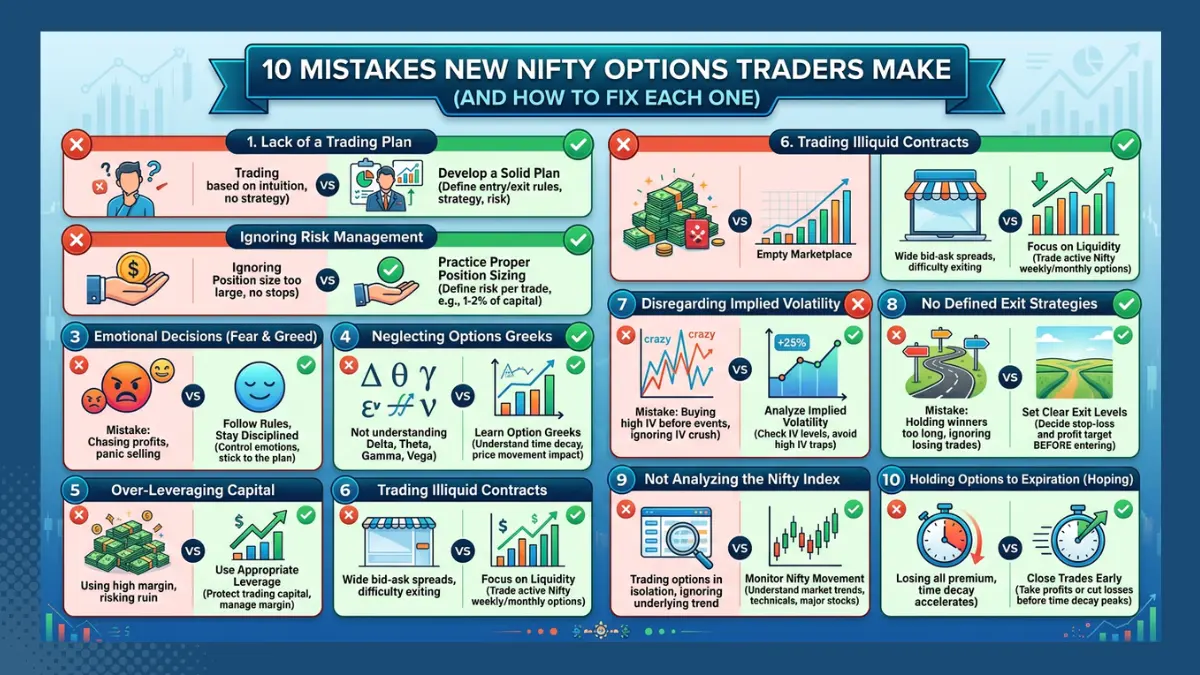
10 Mistakes New Nifty Options Traders Make (And How to Fix Each One)
SEBI's September 2024 study covered 1.13 crore individual F&O traders over three years. Ninety-three percent lost money. The average loss was ₹2 lakh per person. Zerodha's CEO cited SEBI data showing that 16% of active retail traders lost their entire capital in FY25. These are not freak outcomes. They are the predictable result of ten specific, repeatable mistakes that new Nifty options traders make, most of them in the first six months. I made several of them. This article names each one, explains exactly why it costs money, and tells you what to do instead.
In This Article
- Mistake 1: Buying Far OTM Options Every Week
- Mistake 2: Ignoring Theta Until It Is Too Late
- Mistake 3: Trading Without Checking India VIX
- Mistake 4: Using Too Much Capital on One Trade
- Mistake 5: Averaging Down on Losing Positions
- Mistake 6: Revenge Trading After a Loss
- Mistake 7: Following Telegram Tips and YouTube Calls
- Mistake 8: Overtrading: Too Many Trades, Too Often
- Mistake 9: Not Using a Stop-Loss
- Mistake 10: Skipping Practice Entirely
Mistake 1: Buying Far OTM Options Every Week
The logic seems sound at first. A Nifty 24,500 CE costs ₹12 when Nifty is at 23,200. One lot is just ₹780. If Nifty rips 600 points this week, that option could be worth ₹300. That is a 25x return on ₹780. Sounds reasonable.
Here is what actually happens most weeks. Nifty moves 100 to 200 points in various directions, does not come close to 24,500, and your ₹12 option becomes ₹2 by Tuesday's expiry. You do this five or six times in a row. Total cost: ₹4,680. Net return: roughly zero or worse.
Far out-of-the-money options have a delta of maybe 0.03 to 0.05. That means a 100-point Nifty move adds roughly ₹3.25 to your option (0.05 x 100 x lot size of 65). Meanwhile theta is taking ₹1.50 to ₹2 out of it every day. You need Nifty to make a large, directional move and do it within a few days. That happens occasionally. It does not happen consistently enough to sustain a strategy built on OTM lottery tickets.
Mistake 2: Ignoring Theta Until It Is Too Late
Most new traders watch Nifty's price on one screen and their option P&L on another. They cannot understand why the option keeps losing value on days when Nifty moves slightly in their direction. The answer is almost always theta.
A Nifty weekly ATM option loses roughly 9.3% of its premium value per day from theta alone, per Upstox's analysis of Nifty option chain data. Buy a ₹180 call on Wednesday. By Monday morning, if Nifty has gone sideways, you might have ₹90 left. Nifty did not fall. Time just ran out.
The mistake is not understanding this before entering the trade. Theta is not a surprise. It is printed on the option chain. Check it before you buy. Multiply it by the number of days you plan to hold. That is the minimum Nifty move you need just to break even on theta alone, before the market even goes in your direction.
Mistake 3: Trading Without Checking India VIX
India VIX tells you how expensive options are right now relative to recent history. Most beginners never check it. They just look at the premium in rupees and decide if it feels cheap or expensive.
This is how you end up buying an option for ₹440 when you would have paid ₹150 for the same contract two months ago. The contract has not changed. VIX has. Right now in March 2026, VIX is around 22. In January it was below 9. Options are currently three times more expensive by premium cost than they were at the start of the year. A trader who does not check VIX does not know this. They just pay the price and wonder why their option is not moving the way they expected.
There is a second VIX mistake: buying options when VIX is already high, expecting it to go higher. VIX mean-reverts. It spikes on fear events and then normalises when the fear resolves. Buying options at VIX 22 into a geopolitical shock, as many traders did in early March 2026, meant buying at near-peak implied volatility. When VIX fell from 24 back to 19 after some ceasefire signals, premiums compressed sharply even when Nifty barely moved. Those traders faced IV crush on top of theta. Both forces hit simultaneously.
Practice Without Making These Mistakes With Real Money First
NiftyWise's free simulator lets you trade through real historical Nifty scenarios with ₹10 lakh virtual capital. Make all ten of these mistakes risk-free before you trade real money.
Launch Free Simulator →Mistake 4: Using Too Much Capital on One Trade
This one shows up in the SEBI data repeatedly. The very frequent traders, those placing 500 or more trades per year, had an 80% loss rate. Part of that is overtrading. But a significant part is also oversizing individual trades, which turns a string of losses into a capital-destroying event rather than a learning experience.
New traders often put 30%, 40%, or even 50% of their trading capital into a single Nifty option trade. When it goes against them, the loss is proportionally devastating. The psychological damage from a large single loss is also severe. It triggers emotional responses like revenge trading, doubling down, or paralysis, all of which compound the original mistake.
Professional traders typically risk no more than 1 to 2% of total trading capital on any single trade. On a ₹2 lakh account, that means a maximum risk of ₹2,000 to ₹4,000 per trade. Not ₹40,000 or ₹60,000 on one option. That constraint feels limiting. It is actually liberating, because a string of losses cannot wipe you out, and you live to trade another day.
Mistake 5: Averaging Down on Losing Options Positions
Your Nifty call is at ₹90. You paid ₹150. It is going against you. Nifty fell 100 points. You think: if I buy more at ₹90, my average comes down to ₹120, and I only need Nifty to recover 50 points to break even instead of 100. Seems logical.
It is not. Options have a finite lifespan. Every day you wait for the recovery, theta is eating both the original position and the averaged-down position. The underlying problem, that Nifty moved against you, has not changed. You have now doubled your exposure to a losing scenario and halved the time you have to recover from it.
With stocks, averaging down can sometimes work because the stock theoretically has unlimited time to recover. An option expires. There is no recovery after Tuesday. Averaging down on options teaches you to throw good money after bad in an instrument that is counting down to zero.
Mistake 6: Revenge Trading After a Loss
You lost ₹8,000 on a Nifty trade this morning. It stings. You want it back. So you place another trade, bigger this time, to recover. This is called revenge trading and it is one of the most documented patterns in retail trader behaviour.
SEBI's intraday trading study found that loss-makers conducted significantly more trades on average than profit-makers. The correlation between high trading frequency and losses is not coincidental. Many of those extra trades are revenge trades placed after a losing session, when emotional state is at its worst and decision quality is at its lowest.
The market does not owe you your money back. Placing a larger trade immediately after a loss to recover it is not a strategy. It is an emotional reaction dressed up as a plan. Most of the time it results in a second loss that is larger than the first.
Mistake 7: Following Telegram Tips and YouTube Calls
CNBC's analysis of SEBI data found that more than 40% of Indian F&O traders were under 30 and most were influenced by social media and Telegram groups. The trading activity driven by these channels is described as momentum-driven, reactive to peer activity, and often driven by FOMO rather than analysis.
Here is the fundamental problem with following Telegram option tips. The person sending you the tip either has a different entry price than you, a different account size, a different risk tolerance, or a position that is already running before you see the message. By the time you read "Buy 23,500 CE @ market", the sender may have entered at ₹60 twenty minutes ago and the option is now at ₹85. You buy at ₹85. The sender exits at ₹95 while Nifty stalls. Your entry is their exit. You are left holding a position you do not understand at a price that no longer makes sense.
There is also the incentive problem. Anyone charging for trading tips has a financial interest in you staying subscribed, not in you becoming independent. The most genuinely helpful thing any trading educator can do is teach you to generate your own analysis. Tips are the opposite of that.
Mistake 8: Overtrading: Too Many Trades, Too Often
SEBI found that very frequent traders (those placing more than 500 trades per year, or roughly two per trading day) had an 80% loss rate. That is higher than the overall 93% loss rate on a per-trader basis, and it strongly suggests that trading more often does not improve outcomes. It worsens them.
There are two reasons. First, each trade incurs transaction costs: brokerage, STT (Securities Transaction Tax), exchange fees, GST. SEBI's study found the average trader spent ₹26,000 in transaction costs alone in FY24. Across 500 trades, that is ₹52 per trade on average just in costs, before the trade even moves. For options bought at ₹50 to ₹100 premium, these costs represent a meaningful drag on every single trade.
Second, placing many trades forces you into lower-conviction positions. The best traders are selective. They wait for specific setups where multiple factors align. Overtraders fill their time with marginal trades where conviction is low and the probability of being right is not materially better than chance.
Mistake 9: Not Using a Stop-Loss
This is the simplest mistake to describe and the most consistently made. You buy an option with a clear directional view. Nifty goes against you. The option falls. You do not exit because you believe Nifty will come back. It does not come back before expiry. You lose the entire premium.
Or worse: you sold a Nifty option to collect premium. Nifty made a large move against you. The option you sold for ₹30 is now worth ₹180. You hold because you believe Nifty will reverse. It does not reverse quickly enough. You lose ₹9,750 per lot on a trade that was supposed to make you ₹1,950.
The 685-point Nifty fall on 4 March 2026 is a live example from the past two weeks. Sellers who had short puts without stop-losses and who held through that session, expecting a bounce that did not come that day, converted manageable losses into catastrophic ones. The move was not predictable. The stop-loss was the only tool that could have limited the damage.
Mistake 10: Skipping Practice Entirely
In FY24, 42 lakh traders entered F&O for the first time. Of those new entrants, 92.1% lost money with an average loss of around ₹46,000 per trader. These were not all bad traders. Many of them were simply people who entered a complex, high-speed instrument without any structured practice.
You would not sit a driving test without first learning to drive. You would not perform surgery without training. Options trading is not in the same category as surgery, but it is a leveraged instrument in a market driven partly by institutional algorithms, and a beginner going straight to real capital without any practice is placing themselves at a structural disadvantage.
Paper trading on a simulator is not the same as real trading emotionally. That is a fair criticism. But it builds the mechanical foundation: understanding how to read an option chain, what a theta value means in rupees, how your P&L moves when VIX shifts, what it feels like when an option approaches expiry. Getting that foundation through practice rather than through real losses is simply the more efficient path.
🎯 The 10 mistakes: the short version
- Far OTM every week. Delta is too low to make money on normal moves. Theta destroys the position in days.
- Ignoring theta. Check it before buying. Know your daily rupee loss. Know the minimum move needed to break even.
- Not checking VIX. You need to know if you are buying cheap or expensive volatility. Right now it is expensive.
- Oversizing positions. Max 1 to 2% of trading capital at risk per trade. Not 30 to 40%.
- Averaging down. Options expire. There is no unlimited recovery time. One clean loss beats a compounded larger one.
- Revenge trading. Set a daily loss limit. When you hit it, stop. The market will be there tomorrow.
- Following Telegram tips. By the time you read the tip, you are late to someone else's trade. Learn your own analysis.
- Overtrading. SEBI found 80% loss rate for traders placing 500+ trades per year. Trade less, trade better.
- No stop-loss. Set it before you enter. Not during the move. Every single trade, every time.
- No practice. 92% of new F&O entrants in FY24 lost money. Paper trading costs nothing. Real losses do.
Frequently Asked Questions
How much capital should a beginner start with for Nifty options trading?
For option buying strategies, starting with ₹25,000 to ₹50,000 is reasonable. At that capital level, buying one lot of an ATM option costs ₹10,000 to ₹15,000, which is within sensible position sizing limits. For option selling, you need significantly more: at least ₹1 lakh to ₹1.5 lakh in margin per lot under SEBI's 2025 rules, and ideally ₹3 lakh or more to manage adverse moves without forced square-offs. Most importantly: never trade with money you cannot afford to lose, emergency funds, borrowed money, or capital earmarked for something else. The psychological impact of trading with money you cannot afford to lose is itself a source of mistakes.
Is it normal to lose money in the first few months of options trading?
Yes, and the data bears this out. SEBI found that 92.1% of new F&O entrants in FY24 lost money. The average new entrant lost around ₹46,000. This does not mean losses are inevitable with experience, but they are extremely common at the start. The traders who survive and eventually become consistently profitable treat early losses as tuition fees for a very specific skill. The ones who blow up their accounts treat early losses as bad luck and double down. Using a simulator first, then starting with small real positions, is how you compress the learning curve without compressing your account.
What is the biggest single reason new Nifty options traders lose money?
If I had to pick one, it is trading without understanding the mechanics of what you are buying. Options are not simply a cheap, leveraged way to bet on Nifty's direction. They are instruments where time, volatility, and direction interact simultaneously. A trade can be directionally correct and still lose money because theta eroded the premium faster than the move added value, or because IV crushed on a post-event normalisation. Understanding these mechanics is not optional. It is the foundation of every other decision you make.
Should beginners trade weekly or monthly Nifty options?
Monthly options are significantly more forgiving for beginners. Weekly options decay at roughly 9.3% of their premium per day from theta. Monthly options on the same strike decay at roughly 1.0% per day. A monthly option gives you more time to be right. It also gives you more time to understand what is happening to your position before the decay becomes terminal. Weekly options suit experienced traders who can time entries tightly and exit quickly. For beginners, monthly options reduce the urgency that leads to panic exits and poor decisions.
What is the one thing I should do before placing my first real Nifty options trade?
Trade through at least 20 historical scenarios on a free paper trading simulator first. Not to prove you can make money on a simulator, which is easier than real trading because there is no emotional pressure. But to build the mechanical understanding of how options behave: how theta accelerates near expiry, how IV changes the premium, how the option chain shifts as Nifty moves. NiftyWise's free simulator includes historical Budget Day, expiry day, and high-VIX scenarios where you can experience each of these dynamics without risking anything. That foundation is worth more than any tip or strategy you can read about.
Make These Mistakes Risk-Free Before You Trade Real Money
NiftyWise's free simulator gives you ₹10 lakh in virtual capital to trade through real historical Nifty scenarios. Learn from the mistakes above without paying for them with real capital.
Launch Free Simulator →⚠️ Disclaimer: Please Read. This article represents the personal opinions and analysis ofthe NiftyWise editorial team. It is for educational purposes only and does not constitute investment advice, a trading recommendation, or financial guidance of any kind. The reviewer has no financial interest in the platform mentioned. Reviewed from a financial literacy and compliance perspective .No endorsement of any platform is intended. All SEBI statistics cited are from SEBI's updated study published September 2024 (FY22 to FY24) and SEBI's intraday trading study (July 2024). The 16% capital loss figure is from Zerodha CEO's LinkedIn post citing SEBI FY25 data. The 9.3% daily theta figure is from Upstox's published Nifty option chain analysis. Stop-loss percentages and position sizing guidelines cited are general conventions in options trading and not guaranteed risk limits. Nifty lot size of 65 is effective January 2026. Nifty weekly expiry on Tuesday is effective from September 2, 2025. NiftyWise is not registered with SEBI as an Investment Adviser, Research Analyst, or Stockbroker. Past performance, simulated or actual, is not indicative of future results. Options trading carries substantial risk. As per SEBI's updated study (September 2024): 93% of individual traders in the equity F&O segment incurred losses between FY22 and FY24, with aggregate losses exceeding ₹1.8 lakh crore. Please consult a SEBI-registered Investment Adviser before making any investment decisions. Visit sebi.gov.in for a list of registered advisers.