
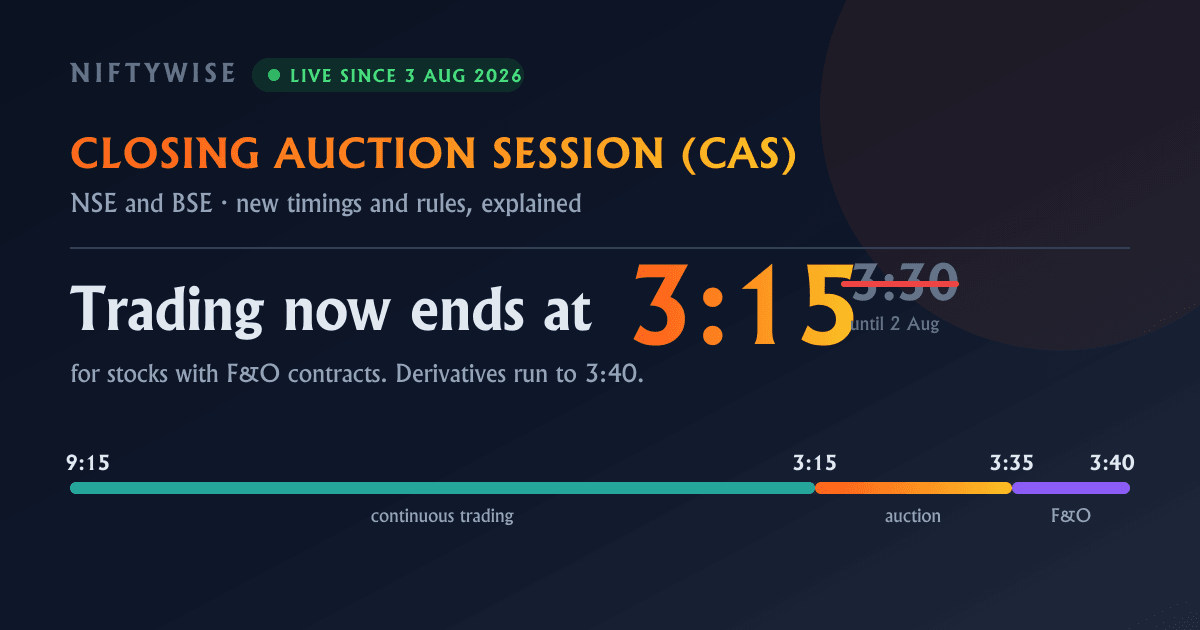
The Closing Auction Session (CAS) is a 20 minute auction, running from 3:15 pm to 3:35 pm, that decides the official closing price of NSE and BSE stocks which have futures and options contracts. It replaced the old method of averaging the last half hour of trading, and it has been live since 3 August 2026.
If CAS has left you confused, there is a reason, and it is not you. Two separate things are happening at the same time, and most of the noise online comes from people mixing them up.
One is already live and has been reshaping your trading day since August. The other is a proposal that has not been decided yet. Tell them apart and the whole thing becomes simple.
Your trading day now looks like this
Before anything else, learn the new clock. For any stock that has futures and options on it, the day no longer runs in one straight line to 3:30.
Two lines from that picture are worth memorising.
- Continuous trading in F&O stocks stops at 3:15, not 3:30.
- Futures and options run until 3:40, ten minutes later than they used to.
And two more that most explainers leave out. There is still a post close session from 3:50 to 4:00 in the cash segment, where trades go through at the closing price the auction produced. And the pre open session was rebuilt at the same time, so the start of your day changed too.
| Pre open, 9:00 to 9:15 | What you can do |
|---|---|
| 9:00 for 5 minutes | Limit and market orders |
| 9:05 for 5 minutes | Limit orders only. Market orders can no longer be changed or cancelled. Closes at random in the final two minutes |
| 9:10 for 2 minutes | Matching |
| 9:12 for 3 minutes | Orders move across into normal trading |
If that shape looks familiar, it should. SEBI deliberately gave both ends of the day the same structure.
What happens between 3:15 and 3:35
The circular splits those twenty minutes into four blocks of five. Each one takes something away from you.
- 3:15 · Reference price and transitionThe exchange works out the reference price and moves orders across from normal trading. You are not entering anything yet.
- 3:20 · Order entry opensLimit and market orders both allowed, and both count towards the closing price.
- 3:25 · Limit orders onlyMarket orders can no longer be modified or cancelled. This block shuts at a random moment in its final two minutes, so anywhere between 3:28 and 3:30. The randomness is system driven, precisely so that nobody can plan for the last second.
- 3:30 · MatchingThe exchange works out the price and prints the close.
The order rules that catch people out
The auction is not just normal trading in a shorter window. Several things you rely on during the day simply do not work inside it.
- Stop loss orders are not allowed. If you rely on one to get you out near the close, it will not be there.
- Iceberg orders are not allowed. Quantity has to be shown in full.
- Your unexecuted limit orders come with you. Anything still resting when continuous trading ends is carried into the auction automatically, apart from stop losses, icebergs, and anything priced outside the auction band.
- Those carried orders keep their place in the queue, ahead of orders placed inside the auction. Touch one to modify it and it goes to the back.
- Market orders are matched first. They are filled against each other by time, then against limit orders, and only then do limit orders meet each other.
Why they replaced an average with an auction
The old closing price was an average of whatever traded in the last half hour. Simple, but soft. If you wanted to nudge a close, you only had to lean on a thin stock late in the day, and the average moved with you.
An auction works the other way round. Everyone puts their orders into the same pot, and the exchange looks for the one price where the largest number of shares can actually change hands. That price is the close.
Before: an average of the last half hour
Thin volume near the bell could tug the number.
Now: the price where the most shares trade
Everyone must show up, so it is far harder to push.
Index funds are the quiet reason this matters. They are obliged to trade at the close, and they were the ones paying for a number that could be moved. A fairer close is a cheaper close for anyone holding those funds.
Who is in the auction, and who is not
The circular is explicit that this is a phased rollout. For now the auction sets the close only for cash-segment stocks that have derivative contracts. Every other stock keeps the old method: the average price across the last thirty minutes of normal trading.
One detail that matters if you trade stock futures. Between 3:15 and 3:40 their price band is pulled into line with the auction's own band of plus or minus 3%, and the usual dynamic widening of bands is switched off for that window.
Three things called "closing price", and only two changed
This is where experienced traders get tangled. There are three different numbers, and the auction touched two of them.
| Which number | What it is | Changed? |
|---|---|---|
| The stock's close | What you see on the ticker | Yes. Now the auction price |
| A contract's daily close | End-of-day value of a running future or option | No. Still an average of its own trades |
| Expiry settlement | What an expiring contract finally settles against | Yes. Derived from the auction close |
The part that is still undecided
Here is where it pays to be precise about what SEBI has and has not done.
The only binding document is the circular dated 16 January 2026, which created the auction and rewrote the settlement rules directly. It replaced the relevant paragraphs of the SECC master circular so that an index contract settles at "the closing price of the underlying index on the day of expiry", with that index close built from "the closing price of the constituents", and a stock contract settles on a volume weighted average of the stock's closing prices across exchanges. That took effect on 3 August 2026 and remains in force.
On 3 September 2026 SEBI issued a press release, PR 53/2026. A press release is not a circular and changes nothing on its own. In it SEBI said, in its own words, that it had monitored the first month of the auction, that a significant area of feedback concerned "the determination of settlement prices of derivative contracts on expiry based on the closing price determined through CAS", and that it "may be proposing certain changes in the methodology", with a consultation paper to follow in about a week.
Financial media have since reported that the consultation paper was published in September and that it floats two approaches: blending the last half hour of ordinary trading with the auction window, or temporarily ignoring the auction and using only the last half hour. Those reports also mention adjustments to session timings and a comment deadline in early October.
We have not reproduced the detail of those proposals here, because we have not been able to verify them against the paper itself. If you intend to trade around the change, or to submit a comment, read the consultation paper directly on sebi.gov.in rather than relying on any summary, including this one.
What to actually do differently
- Intraday in F&O stocks. Be flat by 3:15. Most brokers square off around 3:12, which is earlier than many people expect.
- Trading options. You have ten more minutes than before. The session ends at 3:40.
- Market orders near the close. After 3:25 they are refused. Use limit orders, and do not leave it to the final seconds, because the window shuts at a random moment.
- Holding to expiry. Nothing has changed yet. Watch sebi.gov.in for the outcome of the consultation before assuming it has.
- Anything keyed to the close. Stop losses, fund NAVs and margin all read the closing price, and that number now comes out of an auction.
Four things people keep getting wrong
"Expiry settlement has not changed yet." It has. Since 3 August your expiring contracts have settled off the auction close. What is unsettled is the formula, not whether the auction counts.
"The market closes at 3:15 now." Only continuous trading in F&O stocks. The auction runs to 3:35 and derivatives to 3:40.
"Every stock is in the auction." No. Only cash-segment stocks that have derivative contracts. The rest trade to 3:30 as they always did.
"This came out of nowhere." SEBI consulted publicly in December 2024 and again in August 2025 before the January 2026 circular, and says so in PR 53/2026. The current round is about tuning settlement after watching it run for a month.
What SEBI said on 3 September
The update everyone is reacting to is a single press release, PR No. 53/2026. Stripped to its substance, it says four things.
- The auction has been running since 3 August, created by the circular of 16 January 2026, and its closing price is already the basis for expiry settlement.
- It was not rushed. SEBI points to public consultations in December 2024 and August 2025 before the circular.
- SEBI has been watching the first month and taking feedback from exchanges, brokers, prop desks, mutual funds, FPIs, and from social media.
- Most of that feedback was about one thing: how expiring derivatives settle against the auction close.
The operative sentence: SEBI "may be proposing certain changes in the methodology", with a consultation paper to follow "in about a week".
Summarised from SEBI press release PR No. 53/2026, dated 3 September 2026. Read the original at sebi.gov.in.
Note the word may. A press release is not a circular, and this one changed no rule. It told the market a proposal was coming.
Sources
Binding:
- SEBI circular dated 16 January 2026, introducing the Closing Auction Session in the Equity Cash Segment, effective 3 August 2026. Session timings at para 4.2, reference price at 4.3, price bands at 4.4, order types at 4.5, equilibrium price at 4.6, execution priority at 4.7, carried-over orders at 4.8, settlement prices at 4.9, and the revised pre open session at para 5
Announcement, not binding:
- SEBI press release PR 53/2026, dated 3 September 2026, quoted above
Proposal stage:
- SEBI consultation paper on the Closing Auction Session, market timings and settlement methodologies, reported September 2026. Check sebi.gov.in for the current version and comment deadline.