Open a NIFTY chart on a free TradingView account and there is a line sitting under the price: data is delayed by 15 minutes. For most Indian traders that line is the moment the free plan stops being enough, and it is usually what sends them to the pricing page.
Where they find that the plan everyone still calls Pro is not listed.
TradingView retired the Pro and Pro+ names at the start of 2025. Pro became Essential, Pro+ became Plus, Premium kept its name, and a tier called Ultimate was added on top. Any review still headlined "TradingView Pro" is working from a screenshot older than eighteen months.
Which leaves the question worth actually answering: does Essential, at ₹995 a month, earn its keep for someone whose screen is mostly Nifty and Bank Nifty? I went through the current India pricing page, the data terms and the feature table today. For anyone trading intraday the answer is yes, though not for the reason most reviews give, and not for the total most people expect.
What the plans actually cost in India right now
These are the prices on the India pricing page, and they are the annual rates, which is what TradingView shows by default.
| Plan | Per month | Per year | Charts | Indicators | Price alerts |
|---|---|---|---|---|---|
| Basic (free) | ₹0 | ₹0 | 1 | 2 | 3 |
| Essential | ₹995 | ₹11,940 | 2 | 5 | 20 |
| Plus | ₹2,095 | ₹25,140 | 4 | 10 | 100 |
| Premium | ₹4,195 | ₹50,340 | 8 | 25 | 400 |
| Ultimate | ₹17,333 | ₹2,07,996 | 16 | 50 | 1,000 |
Charts means charts per tab. Indicators means indicators applied to a single chart. Prices shown are the annual billing rate, verified on TradingView's India pricing page in September 2026.
Paying month to month costs more. TradingView advertises a saving of ₹3,600 a year on Essential for committing to twelve months, which works out to roughly ₹300 a month extra if you pay as you go, so somewhere near ₹1,295. The saving it quotes on Plus is ₹6,000 a year and on Premium ₹10,800. Treat those derived monthly figures as approximate and check the toggle yourself before you buy.
Drawn against Premium. Ultimate is more than four times that again, which is why it runs off the end rather than flattening everything else into slivers. Nothing in a retail Nifty options workflow needs it.
The data question, settled
This is the one that matters, and almost every review muddles it. Here it is in a table.
| What you have | Your NIFTY chart | What the NSE data costs |
|---|---|---|
| Free plan | Delayed 15 minutes | Cannot be added |
| Any paid plan, or the free trial | Real time | ₹0 |
NSE real-time data is listed on TradingView's data coverage page at ₹0 for both non-professional and professional users, alongside a 15 minute free delay.
So the thing people assume is the expensive part is not a cost at all. Real-time NSE data is free. What you cannot do on the free plan is attach it, because adding any exchange data package requires a paid or trial plan first. That is what the notice under a free NIFTY chart is telling you when it says you need a paid or trial plan to add the data to your subscription.
Which reframes the whole question in the title. The strongest argument for paying is not indicators and it is not alerts. It is that a free account cannot show you a live NIFTY chart at all, and a paid one can, at no extra charge for the data itself.
Two footnotes worth knowing.
BSE is the exception that costs money. Real-time BSE data is listed at ₹422 a month for non-professional users and ₹3,705 for professionals. For a Nifty options trader this rarely matters, because the contracts you care about are NSE contracts.
If your broker already sells you a data entitlement, link the account. TradingView will honour permissions you already hold rather than asking you to arrange them twice. That matters most for BSE, where there is an actual fee to avoid.
So what are you actually paying for?
Once data is off the table, the paid tiers are selling you room to work. Here is the honest split.
What Basic gives you for ₹0
- NSE index and cash quotes delayed by 15 minutes
- One chart per tab, one saved layout
- Two indicators on that chart
- Three price alerts
- One watchlist
- Ads on the interface
What paying unlocks
- No ads
- Real-time NSE data, which costs ₹0 but cannot be switched on without a paid or trial plan
- More indicators per chart, 5 on Essential up to 25 on Premium
- More charts side by side and more saved layouts
- Far more alerts, 20 on Essential up to 400 on Premium
- Intraday Bar Replay, for practising on past sessions
- Second-based intervals and custom timeframes
- Volume Profile indicators
- Multiple watchlists
Which ceiling you hit first
Set the data aside and the tiers are selling headroom. Two limits do the biting, and neither is the one people budget for.
Indicators per chart. Two is half a setup. A working Nifty intraday chart carries a couple of moving averages, VWAP, and something for momentum or volatility, so you are at four or five before adding anything clever. On Basic you spend the session removing one study to make room for another. Five, on Essential, is roughly where the chart stops fighting you.
Price alerts. Three is the limit that costs you something real. An options trader watching a few strikes, a couple of index levels and a stop is past three before the opening bell. Alerts are what let you stop staring at the screen, and for most retail traders that is worth more than any indicator on it. Twenty covers a normal setup with room to spare.
Indicators on one chart
A working intraday setup needs four or five.
Active price alerts
A few strikes, two index levels and a stop is already past three.
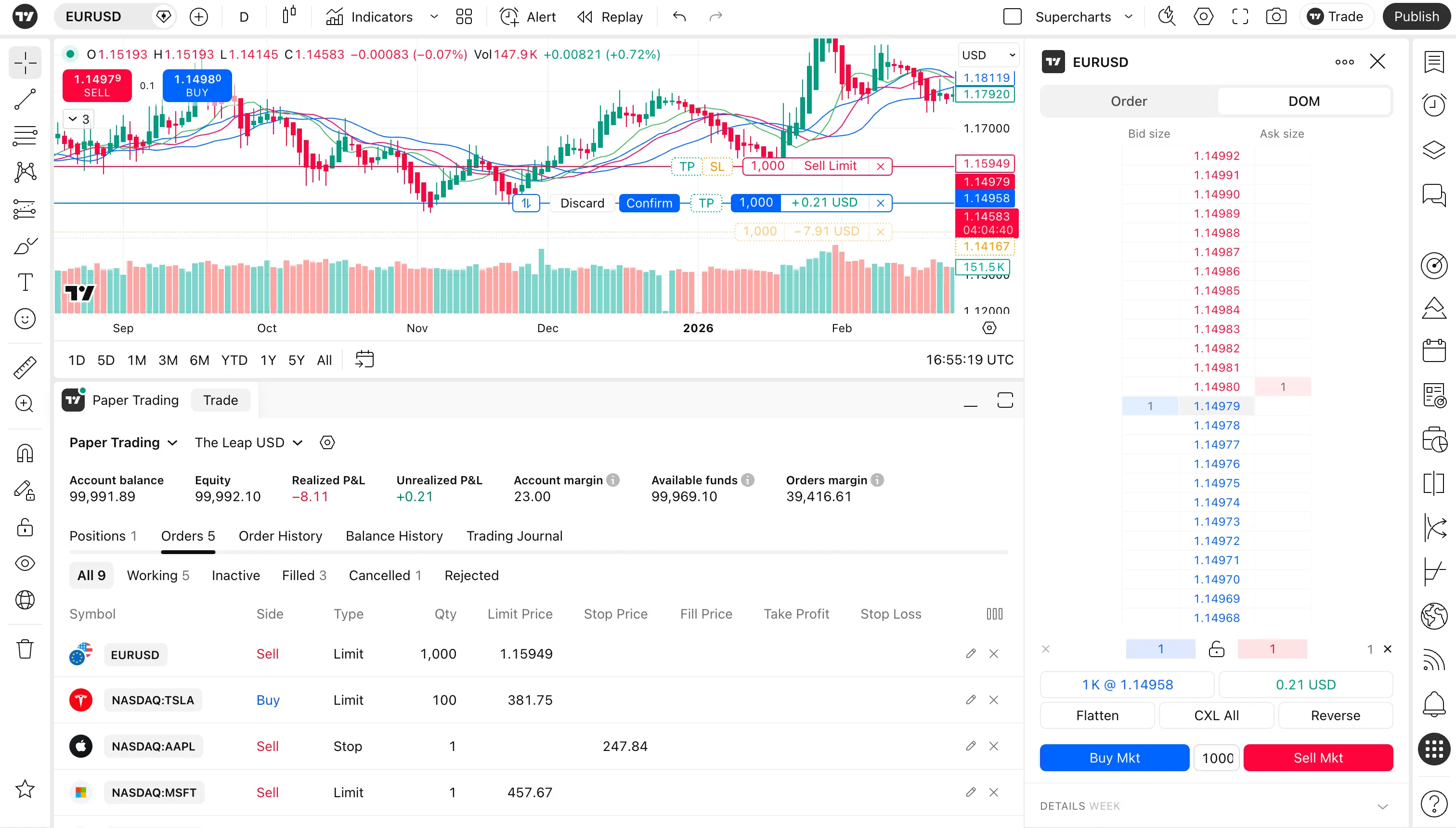
One more is worth naming: intraday Bar Replay, locked on Basic. Replay lets you scrub back into a past session and step forward bar by bar, which is as close to practice as a charting platform gets. If you are still learning to read intraday structure, that feature alone can justify a month or two of Essential. You can also get most of the same benefit for nothing by replaying real sessions in a simulator.
Who should pay, and who should not
- Stay on Basic You are studying rather than trading, you look at charts a few times a week, and a 15 minute delay on the index costs you nothing because you are not acting on the last candle. Basic is a real product for that, not a crippled trial.
- Essential at ₹995 a month You are at the chart most sessions, you want five studies without juggling, twenty alerts, no ads, and Bar Replay to review what you missed. This is the right tier for the large majority of Indian retail options traders, and the jump from Basic is the only upgrade that changes your day.
- Plus at ₹2,095 a month You watch four charts at once, typically index plus a couple of heavyweights plus a broader timeframe, and a hundred alerts is a real requirement rather than a nice number. Worth it for active intraday traders, hard to justify otherwise.
- Premium at ₹4,195 a month You genuinely need 25 indicators on a single chart or 400 alerts running. That is a systematic or multi-instrument workflow. If you are asking whether you need Premium, you do not.
- Ultimate at ₹2,07,996 a year Priced for desks, not for individuals. Nothing in a retail Nifty options workflow requires sixteen charts per tab.
Every paid tier carries a 30 day free trial, except Ultimate at 14 days. Take it before you commit to a year. Thirty days is long enough to find out whether you hit the alert ceiling, which is the honest test.
Trading from the chart with an Indian broker
TradingView lets you connect a broker and place orders from the chart itself. As of today the Indian brokers listed for that integration include Dhan, Fyers, Angel One, Alice Blue, Kotak Neo, Paytm Money, Motilal Oswal, Bajaj Broking, INDmoney and Share.Market, with equities, futures and options supported by most of them.
Two caveats. The integration is a convenience rather than an edge, and it changes neither your brokerage nor your taxes. And the list moves, so confirm yours is on it before paying for a plan on that basis alone.
What actually changed in 2026
The first quarter of 2026 was mostly workflow rather than charting. TradingView added alert presets in January and TPO alerts in February, expanded AI generated summaries for company updates and filings, added the ability to convert a watchlist into a portfolio with real entry prices, and widened market data coverage. The desktop app gained customisable tab workflows and tab sync.
None of it changes the buying decision for an Indian options trader. Alert presets are the pick of the batch, and they make each tier's alert ceiling slightly more valuable than it was.
The verdict
TradingView remains the best charting platform available to Indian retail traders, and the version most people should be using is the free one for longer than they think.
Pro is gone. Essential is its replacement at ₹995 a month on annual billing, and for anyone trading intraday it is not really optional, because a free account cannot show a live NIFTY chart at all.
The good news is that the plan is the whole bill for an NSE trader. The data itself is free; the subscription is simply what lets you switch it on. BSE is the one place a real data fee appears, and a broker entitlement you already hold can cover that.
Then use the 30 day trial, watch which limit you hit first, indicators or alerts, and buy the tier that removes that specific wall rather than the one with the longest feature list.